Friday, 30 August 2013

The Care and Feeding of Houseplants by Art Taylor - Ellery QueenMystery Magazine, March/April 2013

Infidelity.  Watch out.

Felicia is married to a timid man.  She has an affair with Roger who is fitter, stronger more of a man than her husband. 

Never underestimate what a man is capable of.

I did not read this in one sitting but nibbled at it all day.  It is so well written that I kept thinking about it as I was working around the house.  The characters and situation were fresh; Roger's confidence and arrogance - made me dislike him intensely. 

Taylor is an accomplished short story writer.

Art Taylor


Friday, 23 August 2013

The Return of Crazy Horse by Clark Howard - Ellery Queen MysteryMagazine, March/April 2013

Nelson Clay, assistant curator of the Great Plains Native American Museum is approached by a young girl who claims to know where the burial site of Chief Crazy Horse is.

On one level there is the story of how to prove the authenticity of the claim, then there is the conflict of nepotism between Clay and his boss.

As the story progresses interesting relationships develop to a satisfying twist ending.

This is my second encounter with Howard's writing and I look forward to more.
Clark Howard

Monday, 19 August 2013

Book Report #67 - Bossypants by Tina Fey

You can count me as a fan of Tina Fey's.

She has managed to make, what can be a stodgy form, a lot of fun.  Fey is a very intelligent person who has a wonderful way to look at the small things in life.

I've only come to know her through her work on 30 Rock so it was great fun to read about her work on Saturday Night Live and her movies.

She treats the telling of her life much like you'd expect her to tell it at a party; by keeping it light and funny. 

My wife and two daughters loved the book and I could hear each one of them laugh out loud.

I liked it very much (although, being male, I may have missed some of it).

Friday, 16 August 2013

Huddling Place by Clifford D. Simak - The Science Fiction Hall of Fame Volume I

A surprisingly compelling story about a man struggling with agoraphobia.

Although humanity has ventured out to the planets some old psychological problems still plagues society.

After seeing his son off on a trip to Mars he discovers that he simply cannot deal with the crowds and the strangeness of the space port; he is terrified of being away from home and desperately works to get back there.

A few months later he discovers a good friend is dying on Mars and only he can save him.

How will he make the trip?  Will he?

July 1944

Clifford D. Simak

Friday, 9 August 2013

Robers' Roost by Loren D. Estleman from AMOS WALKER The Complete Story Collection

Walker is summoned to the bedside of a dying man.  He is asked to solve the death of a Prohibition era driver who's vehicle broke through the winter ice of the Detroit River.

The dying man, Oscar Chubb, an ex-cop, wants Walker to get enough evidence to prove Specs Kleinstein, a known racketeer and bootlegger, was responsible for his adopted brother's death, who was driving that car.

Walker has to get a vehicle pulled from the Detroit River that has been lying at the bottom for over 50 years.

Even though this is the coldest of cold cases, somebody does not want it investigated.

A solid story.

Monday, 5 August 2013

Book Report #66 - The Overlook by Michael Connelly

Harry Bosch gets a call, in the middle of the night, a body has been discovered on a Mulholland Drive overlook.

The victim is a medical physicist who'd been killed execution style.

It's quickly discovered the victim had access to large quantities of radioactive cesium.  Normally cesium is used in the treatment of cancer; in the wrong hands it could be used in the production of a dirty bomb.

The FBI are instantly involved since this case could have a terrorist angle to it.  Predictably there is tension between them and the LAPD.  When Homeland Security becomes involved mistakes begin to happen caused by inter-agency rivalries.

I've always found Connelly's writing to be an easy read, having been a crime reporter for the LA Times he has the ability to make a story flow.  This book first saw publication as a serialized story in the New York Times Magazine which explains the low page count.  There is very little time given to the struggles of just being Harry Bosch that is usually found in one of his books.

It was still a well crafted, plot driven story that I enjoyed very much.


Michael Connelly

Friday, 2 August 2013

Greektown by By Loren D. Estleman from AMOS WALKER, The Complete Story Collection

This is my fist stab at the Amos Walker cannon.  I thought a collection of short stories would make for an easy introduction to a new series, at least, new for me.  Eastleman has been writing this series since the 1980's.

Amos Walker is like a lot of PIs in fiction; he's a loner and has pals in the police department and at the city newspapers.  Unlike most PIs his character is based in Detroit, the only other author I know of who uses Detroit is Elmore Leonard - good company.

This first story revolves around a serial killer; Walker's client thinks it's his own half brother and wants him to find his brother before the police do.

Walker then has to walk a fine line around the police, never letting on that he's in fact on the case representing the suspect.

The police get their man and Walker discovers the reasons behind it all.

First published in Alfred Hitchcock Mystery Magazine, August 1983.
August 1983

Loren D. Estleman


Friday, 26 July 2013

Mimsy Were the Borogoves by Lewis Padgett - The Science Fiction Hall of Fame, Volume I

That's another one that escaped me.

An inventor creates time machines about the size of a breadbox.  He sends two, packed with his kids' discarded toys, back in time.  The first being sent to the present day (meaning the 1940's.  This story was published in '43, where much of the story takes place.

A young boy, Scotty, finds a strange box by the side of the river.  He opens it and discovers some strange and interesting toys within. He brings it all back home where he and his younger sister begin playing with them. 

It doesn't take long before the parents see these strange objects and begin to take an interest in them.  There is something very strange about these toys; the kids take to them naturally but the adults are baffled by them. The parents begin to worry that these toys are affecting the children. 

The parents bring in a child psychologist to analyze them and the children. It's then they discover that the underlying logic is completely different from our own.

This all gets quite confusing, to me the reader, and in the last few pages the author brings the second box into the story, which was found by Alice Liddell while on a picnic with Lewis Carroll.  She sings a strange song to him and he promises to include the verse in his book, Through the Looking Glass.

Scotty and his sister come across the book which was the last ingredient they needed to cross over into the realm of the inventor who sent the boxes back in time.

It just didn't work for me.

Astounding February 1943

Lewis Padgett was a pen name for the married writing team of Henry Kuttner and C. L. Moore

Henry Kuttner 

C. L. Moore

Monday, 22 July 2013

Book Report #65 - The Chinatown Death Cloud Peril by Paul Malmont

What a HOOT!

Being a lover of pulp fiction what could be better than a pulpy adventure involving the authors of some of the best known titles?  Walter Gibson (aka Maxwell Grant - The Shadow) and Lester Dent (aka Kenneth Robeson - Doc Savage) find themselves ensnared in a mystery involving the death of H.P. Lovecraft, poison gas and Chinese warriors.

There is a wonderful rivalry between these two giants of pulp fiction which walks the line between fiction and fact and is used very cleverly to have them confront the peril from opposite ends.

Malmont did a fine job of including other up-and-coming luminaries of genre fiction of the time (1930's) into the story.  He also managed to include and make very important to the story, Lester Dent's wife and Walter Gibson's love.  Both these ladies played critical roles in pushing the story further.

Once you read this you'll want to dig up as many Doc Savage and Shadow books you can get your hands on.

It took a little while for the story to get going (a function of today's fiction market expecting books of a certain length) which I had to struggle through.  The book was divided into five "Issues" that were roughly the length of the magazines of the day, this was a nice nod to that era's fiction.  It would have been nice if each of these issues would have had stronger cliff-hanger endings but that is a very minor criticism of the work.

I could feel the respect, depth of knowledge and love of the pulps that Malmont brought to this first novel.  Which was confirmed in his tender epilogue.

Yup.  I'm a fan.

Visit Paul Malmont's web page HERE

Paul Malmont


Friday, 19 July 2013

The Weapon Shop by A. E. van Vogt - The Science Fiction Hall of Fame,Volume I

 This one didn't work for me.

I was unsympathetic to the main character who was a small town conservative taking action against a weapon shop that has suddenly opened in his town.

His life and career come unraveled as he tries to get the place shut down.

But there is more to the shop; it's actually a front for an anti-government resistance. 

In the end, I don't understand how this made the list.  Of course, they won't all appeal.

Astounding December 1942
 
A. E. van Vogt

Friday, 12 July 2013

Nightfall by Isaac Asimov - The Science Fiction Hall of Fame Volume I

The planet Lagash is situated in a star system containing six suns.  Consequently the people living there have never experienced night.  Darkness is completely unknown however, every 2,000 years the stars align and are eclipsed by another planet.

We take for granted knowing the night sky which makes for an interesting twist to discover people who've never known stars.

We are told the terrible history of this solar cycle and it's effect on the inhabitants of Lagash.

Written 72 years ago it is still fresh and relevant today.


September 1941

Isaac Asimov


Monday, 8 July 2013

Book Report #64 - World War Z by Max Brooks

I read this in anticipation of the big Brad Pitt movie and after Nathan Fillion suggested it at the Calgary Comic and Entertainment Expo.

It is not the usual linear narrative, instead it is a collection of interviews with key players who survived the events of the zombie plague.

At first this felt like a collection of short stories but after a little bit I started to get into, not so much the rhythm of the book, but how each interview would raise questions in my head and succeeding passages would go to answer them.

This was my first zombie book, I'm not usually a fan of this kind of thing.  I have to admit that this novel is a step up from the, "Man meets zombie, man runs from zombie, man gets eaten by zombie" type of thing.  If you take the "idea" of a zombie plague and run with it a bit; how would society react and deal with such a calamity?  Would law and order survive?  How would our daily lives be affected?  Would there be an economy left behind?  Would functioning governments maintain order and power?

What's fun is that the solution is very easy - kill the zombies.  It's not like waiting for some lab somewhere to discover an antidote will end the conflict.  Each person has the power to "remove" the infected.

What humanity had to deal with was the overwhelming numbers of infected and this was made more interesting by showing how individuals dealt with a loved one who'd fallen to the disease.

If you get over the whole zombie thing, then you are reading a fantastic mental exercise that intelligently delves into serious matters while being a ripping good yarn at the same time.

Looking forward to the re-imagining the movie will present. 

Friday, 5 July 2013

Microcosmic God by Theodore Sturgeon - The Science Fiction Hall of Fame Volume I

First published in the April 1941 issue of Astounding Science Fiction tells the tale of a modern-day Thomas Edison who lives in seclusion on a small east coast island.

His inventions take the world by storm and fundamentally change society in positive ways.  He gets so rich, in fact, that money loses its meaning - only the quest for knowledge drives him on.

However the true villain in this story is - his banker!

Very well done.  It could have been expanded into novel and would have made for a fantastic read.


Theodore Sturgeon


Friday, 28 June 2013

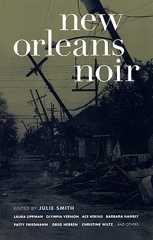
Muddy Pond by Maureen Tan - New Orleans Noir


Muddy Pond by Maureen Tan:  Set in Village de L'Est just a day or two after the storm we meet Sonny Vien as he emerges from his attic bent on rescuing a statue of the Virgin Mary from his back yard.  He's doing this for his wife, who died six months previously, knowing that she'd want him to do so, if she was still with him.

While moving the statue Sonny takes a good look around his ruined neighborhood; he soon discovers that things are very serious next door.

We've been told many times that most crimes are crimes of opportunity but who could imagine that crimes could still be committed in the wake of a natural disaster.  The crime in progress is so despicable that I stood up and cheered at the fantastic and sudden ending.

Monday, 24 June 2013

Book Report #63 - Miles - the Autobiography by Mies Davis and Quincy Troupe

Part of the reason I've not posted in months is that I made a plunge back into music.

When I was in my teens and 20's my stereo was my pride and joy and it really was the best equipment I ever owned.  I made up my mind that I wanted to rebuild that stereo.  I won't go into the details of that quest but I've cobbled together a vintage stereo from eBay, friends and family.

What I really liked about the book was the journey from jazz being the popular music of the day to the birth of rock, funk and soul.

You see, I was born in 1965, just when the world was coming apart at the seams, with race riots, assassinations, an out of control Cold War and the birth of FM Radio.

It was in the 60's that music really exploded into the genres we know to day.  It was 1975 when I started listening music for my own enjoyment - Rock was the default music style that I grew up with.

I started buying music in 1978.  I was never a 'record guy' but I loved listening to them and would do so for hours.  In my later years I've moved from Rock into Jazz back to Rock back to Jazz to the Blues to Rock, again to Jazz and recently Blues plus a bit of 70's Soul.

Miles Davis has always been a touchstone for me when I've been in a Jazz phase.  One of the things that perplexed me was at just how varied his music was; I didn't really understand him.

I loved his old stuff from the 40's and 50's but his later stuff confused me.

What first struck me was how the narrative sounded like conversations were transcribed, verbatim, from taped interviews.  I also had to get over his continuous use of the word motherfucker, but it really didn't take long go get over it and to understand his tone.

Although I was most interested in reading about Miles Davis, who was both a musical genius and drug addicted fuck-up, I was also learning about the birth of the styles of music I've come to take for granted.

While reading I was also buying music; as Davis was explaining certain recording session, I'd buy the album and listen to it.  It's not often you get a sound track with a book, what fun it is when you do!

Friday, 14 June 2013

Book Report #62 - Slide by Ken Bruen and Jason Starr

Continuing from Bust we follow the out-of-control life of Max Fisher.

In this go-around Max is reinventing himself as a hip-hop crack dealer.  Pretty outrageous for such an un-hip, self-centered white guy.

I loved this book.  I must have had an "I can't believe what I'm reading" look on my face the whole time I read it.

It was a ride.


Monday, 25 March 2013

Book Report #61 - Bust by Ken Bruen and Jason Starr

Oh what fun!
Reads like an Elmore Leonard in that i never knew where the story was going to take me.  Random events and pure, believable, chance cropped up to throw the plans of the principal characters.

Visually this could very well be a Quentin Tarantino film; the violence is quick, brutal and unexpected.  There were great gobs of dark, dark humor in here too.  So if you like either Leonard or Tarantino this book is for you.

The good news is that it's the first in a trilogy.

So, what's it about?  One of the most unlikable guys in literature decides he wants to kill his wife because he certainly doesn't want a divorce and give up half his money.  Through his mistress he hires an assassin who calls himself Popeye.  And that's the only part of his plan to goes as he wants it.  From then on the book is like an amusement park ride - you just don't know what's going to happen next.

There is nothing I love more than reading about an idiot's life as it starts to spiral out of control and how he deals with it.

This was great fun and I'm already reading the sequel - Slide.