Monday, 29 October 2012

The Hebras and The Demons and the Damned by Brenda Cooper

Even though this is a story about colonists trying to survive on a new planet it really lacked the SFness I like.

To me, there has to be some technology involved otherwise it's just literary fiction hiding on another world.

These colonists are trying to cope with the indigenous wildlife by domesticating a herd of "space-horses" while being aware that they could be attacked by a pack of "space-wolves" at any moment.

This is rally just a western, a ranching story; I'm well aware of the Space Western sub-genre but at least that type of fiction has fun blending the tech with the tumbleweeds.

I was constantly taken out of the story by my thoughts that this could just as easily been set in Africa or Wyoming in the 19th century.

Sure, it all works as SF, but just not for me. I guess I found it too western and not enough space.

Cooper's writing, however, is superb, she kept me engaged enough that I kept reading to the end. I'm not afraid to quit a story if I'm not enjoying it. Cooper had a confident way of telling the story that kept me reading.

To me, the best example of space-western is Firefly.

Would I read more from Cooper? Absolutely, she's that good.
Brenda Cooper

The author's website is HERE.

Brenda Cooper's Bibliography is HERE
First published in Analog December 2010


Friday, 26 October 2012

Becalmed by Kristine Kathryn Rusch

This is a nice stand-alone short story, set in the Diving universe.

I'll admit right away that I really don't know where it fits in but I have fired off an email to the author asking the question.

Here we follow the story of Mae, a linguist assigned to a diplomatic corps, who is suffering from amnesia caused by PTSD.

It's a chilling story where memories of a massacre keep seeping back into her consciousness. When ever a new memory emerges she wants to retreat and not deal with what she's gone through. But she needs to know ...

Rusch does it again, she's simply flawless in creating believable characters we can care about.

Even though Rusch uses the tired old SF trope of a diplomatic mission to prevent war between two unpronounceable alien cultures, the mission only serves as background for our character's trauma.

The use of flashbacks was intense and I was just as repulsed as Mae by what she remembered.

It was a very good read.
Kristine Kathryn Rusch

The author's site is HERE

Monday, 22 October 2012

To Hie From Far Cilenia by Karl Schroeder

What a neat story!  Part thriller, INTERPOL is looking for some missing plutonium, part Matrix, the chase is mostly conducted online.

What was fun was how the author just expanded on current technology.  Today, virtual reality is pretty much a bust but augmented reality is starting to make in-roads into the gaming world and everyday apps. 

Wikipedia describes Augmented Reality like this:

Augmented reality (AR) is a live, direct or indirect, view of a physical, real-world environment whose elements are augmented by computer-generated sensory input such as sound, video, graphics or GPS data. It is related to a more general concept called mediated reality, in which a view of reality is modified (possibly even diminished rather than augmented) by a computer.

Mapping superimposed
onto the real world.
In the story this is accomplished with special glasses and ear buds.  To track down the plutonium a virtual game called Rivet Couture, which is a steam punk world.  Once the glasses are on modern buildings are removed and Victorian buildings take their place, traffic noises are replaced by the sound of horses and wagons.  This is all superimposed on the real world so when a person walks across a real street that street is also "real" in the virtual world only a delivery truck is replaced by a team of horses.

It was all very cool and the characters could, and often did, take off their glasses just to look around and see where they were in the real world.  The beauty of the world was the blending of the real with the virtual and just how authentic each one really was.

It all comes to a thrilling conclusion on the high seas!

Lots of fun.
Karl Schroeder

Schroeder's website is HERE.


Friday, 19 October 2012

Book Report #50 - Go Like Hell by A.J. Baime

Recently, I've started to develop an interest in racing; particularly endurance racing.  Le Mans is the grand-daddy of all endurance races, it runs every June and is the pinnacle of the sport, even though it's only one of a series of eight races in the FIA World Endurance Championship.

Le Mans has a long and wonderful history.  In this book A.J. Baime looks at a specific period in the history of the race, the 1960's, when Ford declared war against Ferrari.
Ferarri 330 P3
 

Oh my, some of the iconic names that swirled around that period; Henry Ford II, Enzo Ferrari, Lee Iacocca, Carrol Shelby, Bruce McLaren, ...
Ford GT 40

It was a story about passion and determination just as much as it was a story about engineering.  It read like The Right Stuff which was appropriate for the time as the United States was locked in a battle with the soviets in the greatest race of all - to land a man on the moon.

It read like a novel with so much going on on the human side that it was simply impossible to put down.  I loved this book.  I dare say that it's best to have at least a passing interest in auto racing but not necessary to enjoy it. 

One aspect that I found very interesting was how the Ford Motor Company was run.  The infighting between Henry Ford, Edsel Ford and Henry Ford II made for a nice rounding to the events on the track.  This added depth shed a lot of light on the times, after all, Ford cars were a big part of North American society and it had an enormous impact on domestic life.

It would have been easy for Baime to get lost in the cars themselves but he never did because it's the people who matter in this story.  The cars are the objects produced by the determination and passion of the people who financed, built and raced them.
A.J. Baime - author
You can find the book HERE

FIA World Endurance Championship is HERE

Official Le Mans website is HERE


Monday, 15 October 2012

The Bearded Lady by Ross MacDonald

This novelette was first published in 1948 and was a fine, plot twist infused story with a missing friend of Lew's, a missing painting and a missing sketch of a bearded woman.

My God, everybody in the story had a part to play in the deaths!  It was fun and cleanly written.

Ross MacDonald


Friday, 12 October 2012

Death by Water by Ross MacDonald


Originally written in 1945 this story did not see print until 2001 in the three-story anthology, edited by Tom Nolan, in the book Strangers in Town.

The story was about a nice old millionaire living in a hotel with his wheel chair bound wife.  He befriends many people in the bar and is thrown out of the pool when he and his newly met friends go for a midnight swim.  The next morning his is found, dead, at the bottom of the pool.

Lew Archer investigates, on behalf of the hotel, to confirm that it was an accident and not something more.  Since there is a sizable inheritance involved it's important to discover the truth.

I liked it, it was a straight-ahead whodunit. Lew Archer starts to show his character here.

Information on Ross MacDonald can be found HERE.

Wednesday, 10 October 2012

Harry and the Bird by Frank Zafiro

Holy crap!

Two cops are coming on shift when they notice Harry, standing outside on the grass, staring at a bird feeding there. 

You better be sitting down when you read this short but intense story about Harry, a cop who's gone through a bit more than he can handle.

This is really good stuff.


Frank Zafiro

Monday, 8 October 2012

Christmas Eve by Michael Connelly

This came from an ebook, purchased from the Kobo store, called "Angle of the Investigation" a collection of three short stories with Harry Bosch.

Connelly has a very clean way of writing that makes reading his stories effortless.

In this one Bosch investigates the death of a thief found in a pawn shop. There is also a touching side story about a saxophone found in the thief's apartment.

I've had the book for a while now; I'm glad I finally got around to reading it.
Michael Connelly

Michael Connelly's website is HERE

The eBook can be purchased HERE

Friday, 5 October 2012

The Bastard Mummy By Frank Zafiro

 One of the next generation of crime fiction authors that I keep an eye on, Frank Zafiro has a steady way of writing that is authentic and readable.

He's a talented short story writer with over 50 published in both paper and digital form.

Most of his novels and shorts are set in River City, a slightly fictionalized version of Spokane, Washington. (Ed McBain did the same thing with Isola, his fictional New York city.). I've often wondered why authors insist on creating new cities. Perhaps the actual city is missing key features the author(s) need or maybe it makes the writing simpler, in that you don't have to worry about putting a real business or neighborhood in a bad light; you can't offend anybody when describing a fictional place. In any case it's fun to read and its refreshing to have a story set somewhere other than New York or LA.

In "The Bastard Mummy" an artifact is stolen from the local museum. It's a straight ahead theft, no bodies present, at least no fresh ones, that relies on real detective work. Sure there is forensic work to help the investigation but this mystery is solved the old fashioned way, by interviewing the suspects, building a time line, hearing alibis and trusting instinct and intuition.

I also liked the casual sense of humor between the two detectives. You really get the feeling that they've worked together for a while and that Zafiro is also familiar writing about them. Which give an over all sense of confidence from the author that comes through on the page. I felt like I was in experienced hands while reading it.
Frank Zafiro

Frank Zafiro's website HERE

You can download the story HERE

Wednesday, 3 October 2012

Burning My Masterpiece by Frank Zafiro


Wow.

This one kept me guessing. Brian is in the middle of getting a divorce. He's suffering from the terrible emotions that come with it.

Through out the story we kept riding the emotional tides that were controlling Brian's thoughts and actions. We know nothing about Brian that would give us a clue as to how he'd react to his circumstances. I kept hoping he'd handle it better than he does.

I'm not going to lie, my heart skipped a beat and I had to re-read the last few paragraphs to make sure I'd read it right.

Zafiro has a wonderful way of letting you get inside the head of his character that understanding him is natural.

Wonderful, desperate, lonely, ...

Frank Zafiro

Monday, 1 October 2012

Find the Woman by Ross MacDonald

For a first effort and for its time, the story was pretty good; although the murder itself was a bit far-fetched.
Other than an unlikely MO the characters were well written and the story had any easy flow.  Lew Archer himself did not stand out much in this one.
 
This is the first Lew Archer story that was published in the June 1946 issue of Ellery Queen Mystery Magazine under his real name, Kenneth Millar.

Information on Ross MacDonald can be found HERE.


Friday, 28 September 2012

Steadfast Castle by Michael Swanwick

What a fun little story!

This is a quick murder mystery set in the not too distant future. It's very easy to imagine a future where a cop is interrogating the AI of the house a suspects lives in.

Very well imagined and fun. Then it turns dark in a hurry.

Loved it.

The author's website is HERE.  But, be warned, it's out of date.

More current information can be found HERE and HERE.

The story was first published in the September-October issue of Fantasy & Science Fiction.

Wednesday, 26 September 2012

Baker-124 by Frank Zafiro

Officer Zack is called to a run-down apartment building to assess the safety of a child.

It's a heart breaking situation for him. The story is well told and shows how frustrating it can be to be a cop.

This has the definite feeling of being a personal experience of Zafiro's.

Frank Zafiro

Monday, 24 September 2012

Book Report #49 - Star Trek: Risistance by J.M. Dillard

This book filled the need I had of reading some science fiction where I didn't need to learn all about a new universe.

There is something comforting about being able to dip into a world and have it be familiar.

This book takes place just after the last of the Next Generation movies. Picard is trying to assemble a new crew and is assigned the task of negotiating peace between two races. One of which has joined the Federation. (How many times has that situation been used?)

The mission is interrupted when Picard hears the thoughts of the Borg for the first time in years. He tries to convince Starfleet to let him investigate this new threat. You know how it goes; Picard disobeys his orders to wait for an expert to join the Enterprise and heads off, on his own, to confront the Borg.

I found the book a bit dry and slow, to tell the truth. Although I was happy to read about the crew that remains; Picard, Dr. Crusher, LaForge and Worf; the story was bogged down by the author continually trying to tell three stories at once and by repeating scenes from the different points of view.

Even in the climactic battle Dillard kept taking us back in time to tell every angle of it. I found it distracting and frustrating. I don't want to find out what happens next by first having to hear about what happened to somebody in the next room, especially if it has no bearing on the main plot.

This type of story telling is used a lot in thrillers but, in most cases, the differing story lines merge for the "thrilling conclusion" so there is only one plot line to tell in the final chapters.

This book was only okay.

At least I got my Star Trek fix from it.

More on the author can be found HERE.  (Dillard is a pen name for Ms. Kalogridis)


Friday, 21 September 2012

The Roads Must Roll by Robert A. Heinlein

Have you ever imagined what our cities would look like if the automobile was no more?  Seems almost impossible given, just how important and integrated into our society they are.

In Heinlein's world fossil fuels became so rare and valuable (sound familiar) that the US government decided that the military should have priority access to it.  Fuel prices became so expensive that a new method of mass transportation was created, he re-imagined roadways to be a series of conveyor belts each one going a bit faster than its neighbor, up to speeds of 100 MPH.  These roadways were powered by solar panels; very well imagined considering this story was published in 1940.

At the time the leading thinker on photovoltaic energy was Albert Einstein, who won the Nobel Prize in 1921 for his work in the area.  Look HERE for more information on that.

It takes a lot of work to keep the roadways rolling, during this story a revolt unfolds from the trade unionists that maintain the infrastructure.

This has all the right ingredients to make a fine modern day science fiction, action movie.  While reading it I kept thinking this story had the same look and feel of the movie I Robot - a gleaming city on top and a gritty world underneath it all, keeping it all running.

Good story even if the end of it is a bit clunky.  I'm sure it could be improved in the movie. (Just kidding)

Information or Robert A Heinlein can be found HERE and HERE
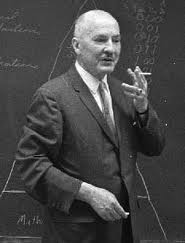
Robert A Heinlein
The story was originally published in Astounding Science Fiction, June 1940