Saturday, 30 June 2012

The Authentic Rose by Terence Faherty - short story review

Ellery Queen Mystery Magazine
September/October 2000

Set in the 1950's. Hollywood Private Investigator Scott Elliot is sent to New Mexico to authenticate a painting purchased by a wealthy client.

Elliot walks into a complex web of emotions, passion and loyalties and in thrown in to a murder investigation along the way.

I found the story well constructed and I especially enjoyed the sense of place it created. I could smell the dust, feel the heat, see the washed out quality to the light under a burning sun and feel the relief of a cool tavern and cold beer.

The author's website is HERE


Wednesday, 27 June 2012

Round Trip by Rail by Gwen Davenport - short story review

Ellery Queen Mystery Magazine
September/October 2000

I liked this story quite a bit. It had a gentle, light touch that I found easy to read and that I wanted to come back to it each time I put it down.

It's the story of a man stuck in a bad marriage and how he chooses to escape it.

One day he just disappears.

Sadly Gwen Davenport died in 2002


As far as I can tell this story was never collected in book form.

Monday, 25 June 2012

Whatever it Takes by Benjamin M. Schutz - short story review

Ellery Queen Mystery Magazine
September/October 2000

The author describes it as "Hardy Boys for the nineties."

And that's a pretty apt feel to the story. Sean and Matthew are a process servers who go about town handing out subpoenas and court summons.

The are pretty good at it too; we get to see all the clever ways they " get their man."

In an effort to make some extra money, the boys are allowed to go through The Icebox; literally a shoe box filled with papers that were never successfully served.

They take on the case of a deadbeat dad who's not paid his child support in years.

It becomes a challenging moral situation for Sean and Matthew - one with a satisfying end.

Sadly the author passed away in 2008


This story was collected in the book Mary, Mary, Shut the Door.


Saturday, 23 June 2012

Kim Stanley Robinson - short story review


Out Town was a creepy little story that ended with a glimmer of hope.

The art scene is very different in this particular future. Sculpting has changed completely; instead of using clay, or stone, or wood artists are now using humans, grown in vats, and then taught a skill, such as dance.

The artist then "freezes" the subject in a force field and puts it on display.

This stirs up all kinds of ethical subjects and the story is chilling because the attitudes of the characters is opposite to ours today.

I believe that if we could grow humans they would quickly have rights.

Here we meet two artists, one who represents his time and place in the narrative and the other is closer to we readers in the present.

It's a very effective story and I won't spoil it for you by telling you any more. It will stay with you as any great story will.

You can read it HERE

The author's website is HERE

The eZine this story was published in is HERE

PS - I've subscribed to this magazine.

Thursday, 21 June 2012

The Collusionists by Scott Mackay - short story review

Ellery Queen Mystery Magazine
September/October 2000


This was a satisfying read about a woman who is wrongfully charged with the murder of her husband.  The cast of characters include; the artist through who's eyes we see the story, his brother who had an affair with the woman charged and the traumatized daughter.

The clues are there and were put together cleverly.  Loved it.

You can find the story only in this issue of EQMM

The author's website is HERE

Saturday, 16 June 2012

The Merchants of Venus by Fredrik Pohl - short story review

This is a longer story (32,000 words) about a down-on-his-luck prospecting guide who lands very rich clients just when he really needs them.

The story is about Audee Walthers a man who once lived on Earth but now makes his home on Venus.  Trouble is Walthers is dying and needs a large influx of money for a liver transplant.  He is lucky enough to meet and contract with a rich couple on an adventure holiday from Earth.  The couple wants to go on a prospecting tour but, on Venus, it's not mineral wealth that people are prospecting for - it's archeology.  Venus was once populated by a race dubbed the Heechee, who once lived in under-ground tunnels, and who mysteriously left the planet.  Finding unexplored tunnels and any artifacts can make a person instantly wealthy.

There are numerous lies and double-crosses in the story.  This is what I look for in a SF story; I want to see real people struggling to make a living doing the kinds of things that people do right here on earth; like trying to out-fox each other for money.  I don't need FTL travel and I don't need aliens mucking up the story to make it work for me but I do love the hardware.  Give me space and a bucket-of-bolts space ship and I'm hooked.

I came to the story via a wonderful on-line service provided by Best Science Fiction Stories, conveniently found at:   http://bestsciencefictionstories.com/ 

If you decide to subscribe you'll get near-daily updates from them.  The emails themselves are wonderful; not only do they tell you a bit about the story and where to read it but they will also give you a bit of background on the author and the story itself, like if the story is part of a much larger series of novels, if it won any awards and if it was collected in book form along the way.  I highly recommend the service.

You can find an example of the email that brought me to this story HERE

You can find the story HERE

 Information on the Author can be found HERE

Tuesday, 12 June 2012

We Dragons by Tim Sevenhuysen - short story review


Nice.  Really nice.

A small team lands on a planet to survey it for possible terraforming.

The hope is to find the planet devoid of sentient beings; along the way they discover they are not alone.

The story works on lots of different levels; a strait SF tale of exploration but it's also a morality tale; what do you do when faced with a perceived failure?  How much can you trust those who surround you and you ultimately rely upon?  How do we really judge a hero?

There's quite a bit going on in this story - it could easily have been expanded to novella length and would have benefited by the extra breathing room.

And that is my only complaint - it was too short.

Keep an eye on this author.

The story can be found HERE

The author's website is HERE

For more SF goodness visit Raygun Revival

Tuesday, 5 June 2012

Estimated Time of Arrival by James Bambury - short story review.


Having seen most Star Trek shows I'm very familiar with the term "colonists."  Those plucky farmer types who just want to start a new life, living off the land of some far away planet.

This fun and quick story is aptly titled.  We all know how fast technology can change (anybody remember a 14.4 dial-up modem?)  In this story Moore's Law has a profound impact on their lives as a mysterious ship, from Earth, lands in the middle of the colony.  The captain of the new ship steps out and greets them by saying "Hello, bumpkins!  I just bought this planet."

From there on things happen quickly and I was reading it all with a smile on my face.  It was how Bambury handled the characters that made funny and serious at the same time.  Maybe funny is not the right word - absurd is a better choice.  You can see how the circumstances in the story happen now and have happened since the dawn of time.

I enjoyed this story.  It reminds me that there is still science fiction being written that I enjoy reading.

You can read the story on-line HERE

The author (a Canadian) can be found HERE.

You can enjoy new Space Opera at Raygun Revival HERE

Tuesday, 29 May 2012

Let's Get Lost by Lawrence Block - short story review


Ellery Queen Mystery Magazine
September/October 2000

Matthew Scudder in the early days; still on the force, still married and still drinking, hires himself out as a "fixer."
I'm always impressed at the ease Block can tell a story.

Lucky you, you can read this story for free on the Mulholland Books Website.

Part One

Part Two

The author's website is HERE


Tuesday, 22 May 2012

Season of the Camel by Edward D. Hoch - short story reveiw


Season of  the Camel 

by

Edward D. Hoch

Combine a retired British Intelligence agent on vacation in Egypt, Camel fights in Turkey and stolen plans for a top secret microchip and you have a rather interesting story.

As far as I can tell this story was not collected.

You can read more about Hoch HERE

Friday, 18 May 2012

Book Report #44 - Moneyball by Michael Lewis

by
My first exposure to the book was from watching the Brad Pitt movie of the same name.  Sue and I both loved the movie and placed it in our personal top 3 of 2011; which made giving me the book as a Christmas gift a sure thing.
The book centers on the Oakland A's and Billy Beane, the A's GM.  Oakland has always struggled against the big league payrolls of other teams.  Where top teams have hundreds of millions of dollars to spend on players Oakland had a budget in the tens of millions.  Money can indeed buy championships but Billy Beane tried a different approach to build a winning team.  Instead of paying for stars he gathered undervalued players from around the league who had one thing in common - the ability to get on base.

Instead of relying on old school scouting that relied as much on gut feelings and how good a player looked in a uniform, Beane turned to something called sabermetrics.  Sabermetrics is the study of baseball statistics and it attempts to take subjectivity out of evaluating the performance of a player.  By looking for players with a strength in getting to first base rather than players who can hit home runs, Billy Beane created teams that had some of the best regular season records in all of Major League Baseball.

The book spent a lot of pages explaining the origins and value of Sabermetrics and on how many statistics are derived and calculated.  This made for some pretty dry stuff but Lewis was shrewd in the book's layout and sandwiched stories of marginal players, who'd been transformed under the encouragement of Billy Beane, between the necessary chapters that dealt with math.

Beane was by no means a saint who nurtured players, quite the opposite, he was ruthless in making deals and trades.  Some of his trades were mind-bogglingly complex and were a real treat to read about.

I am a baseball fan but I'm not fanatic about the game.  For a reader who is really in to baseball and the things that happen behind the scenes this book is a must read.  But for a guy like me this book has done a lot to explain the game that is played off the field; it's given me a better understanding and appreciation of the sport.

This is a very useful, intriguing, informative and entertaining book.

Billy Beane


Tuesday, 15 May 2012

Just Like Old Times by Rober J. Sawyer - short story review

Robert J. Sawyer a Canadian SF icon.  This guy can write; there is something about his style that I find so pleasurable to read.  His writing seems effortless.

This came to me via the Best Science Fiction Stories email service and tells the story of a convicted serial killer sentenced to "death" by chronotransference - a method of downloading a person's mind into the brain of a person from the past.

The story touches on many subjects that Sawyer enjoys writing about; dinosaurs, time travel, the up/downloading of human consciousness.

The fun aspect of the story, and a distinctly Canadian one, is getting around the nastiness of capital punishment.  Downloading a mind into another mind, of a person from the past, who is about to die seems like a nice way to achieve an execution without getting our hands dirty. 

The convict convinces the judge to transfer him to a Tyrannosaurus Rex.

I know, sounds strange but give it a try, it's only 3,800 words.

The story can be found HERE

The author's website is HERE

This short story was collected in Dinosaur Fantastic

Try the email service Best Science Fiction Stories


Wednesday, 9 May 2012

The guilty pleasure of reading

Reading is held in high regard. It is my favorite pass time but it does come with a cost.

Reading is a solitary activity. It does not lend itself to conversation unless the parties talking have each read the same book. When I read I'm usually locked away in a room, by myself, not talking to any one.

That's part of the cost. As much as I love it, it is a bit of a selfish act. So it's hard to find the time to read guilt free.

Then there's the reading itself; what do you read? Classics, literary fiction, genre fiction, magazines, newspapers, etc.?  I love fiction above all other types of reading. But I sometimes come away feeling like I might have spent my time better by reading something more important.

I've decided that I read for my own pleasure and knowledge. I'll follow my heart as to what I read.

There is so much joy to be found in books that I can't help but be drawn to book shops of any description. Used bookstores are the best of all. There you'll find treasures long out if print at discounted prices.

One day eBooks will open the entire back list of the written word at an affordable price but right now the book readers are ahead of their time.

Content is still very expensive. I was looking for a Dirk Pitt adventure that is over 30 years old and was stunned to see it for sale as an eBook for over $10.00!! How can this be? Surely vendors know that you can get the same book for less than $2.00 in a used book store. Or Zero if you download a pirated copy.

You can wipe out most of the piracy in media by simply charging a realistic price for the product. $10 for electrons? No way. $2.99? Much better. Saves me the trip to the used bookstore. $0.99? I'm not even going to look anywhere else; I'll just download a copy.

If publishers embraced eBooks as simply another type of book they'd be able profit from it.  It used to be that the hard cover came out first then, a year later, the paperback.  Why not wait another six months to a year and then release the eBook?  And while your at it offer the entire back list of an author in eBook as well.  Some people, like myself, are completists and want to read books from the beginning.  Surely there is money to be made from that.

iTunes has sold billions (that's with a B) of songs at $0.99. Books would sell just as quickly at a reasonable price.


Wednesday, 2 May 2012

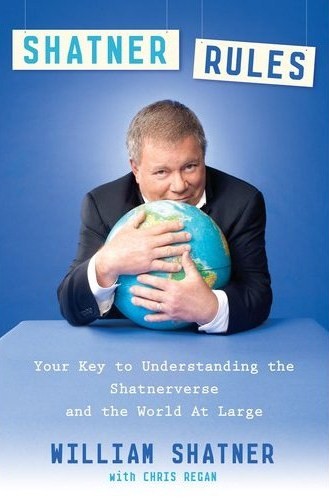
Book Report #43 - Shatner Rules by William Shatner

by

Following close behind his wonderful memoir, Up Till Now, Shatner Rules is a fun romp through the life and mind of William "call me Bill" Shatner.  There is quite a bit of overlap from his memoir but this books' tone is much more like sitting in on a conversation with the man.  

You'll hear a lot of the same anecdotes but with a sense of humor and the wisdom gained from the passing of time.  Mostly it's tongue in cheek but there are many moments of clarity.

In chapter 3, titled Busy is Measured in Units of Shatner,  he explains:

"How do I keep up on a two- to three Shatner day?  I keep mindfully aware that another day is around the corner, another day for me to play a part, another day for me to get things done, another day to make sure the dogs aren't setting their sights on the sofa.

That's how I do it.

The sweet spot of the book is how Shatner connects  his reaction to his 40th birthday compared to his 80th; which is at once touching, scary and hopeful.

He also goes on the tell the story of his lifetime achievement awards and concludes with:

"There's finality to this life achievement business that I want no part of.  As long as you're able to say "yes," the opportunities keep coming, and with them, the adventures.  Say "no" to fear and complacency.  Keep saying "yes." and the journey will continue.

In this, my eightieth year of my life, I should be settling down, taking it easy, resting on laurels.  Forget it."

My favorite rule?  (Use your best Shatneresque voice here)

Get. Out. Of. Bed.

So,

Buy. This. Book

It's Shatner's World. We Just live in it.

Friday, 27 April 2012

Murder in a Time of Siege - short story review

Murder in a Time of Siege
 by

Set in the town of Mafeking, 1899, during the Boer War this is a nice bit if historical fiction steeped in British resolve.

More a tale than a mystery one can try to solve while reading, it still had a satisfying puzzle to it.

This story was collected in:

Past Crimes: Perfectly Criminal 3

The book is sadly out of print but you can still find copies in the used book market; you can start your search HERE. 


Wednesday, 25 April 2012

Abandoned book - No Rest For The Dead


There are two kinds of deaths that scare me; trapped in a sinking ship with the water rising and capital punishment.  Both of these scenarios send shivers down my spine.  It must be the wait that terrifies me; the certainty that you are going to die and those critical moments when death is upon you.

In No Rest For The Dead the story opens with the convict waiting in her cell for the warden, chaplain and guards to come and get her.  Then entering the death chamber and seeing the gurney with all the medical equipment waiting to perform a lethal injection.  Gha!  Oh my god! Instant lump in my throat and elevated heart rate!  

The scene was so well written that I had to stop reading for a while just to recover from it.  Oh, and did I tell you?  The execution does not go well.  Shit. 

No Rest for the Dead is an interesting project; each chapter was written by a different author, each one of them best-selling.

--------

The story truly begins long before the events that open the book.  We follow "Christoper Thomas", curator of a prestigious San Francisco art museum, as he steals valuable art and uses a female  staffer for his own gains.

He's arrogant and despicable and I was very happy with the knowledge that he would soon be dead. But the book was taking too long to get to the end of his story and into the meat of novel that I found myself putting it down for days.

It's well written and I have no complaints about that but all if these events were explained on the dust jacket so I find myself wondering when these guys are going to stop with the exposition and get on with the story of righting a wrong.

---------

The discovery of the body - oh boy -  wonderfully disgusting  and scary.

A perfect set up for the Kathy Reichs chapter

---------

Page 118, that's as far as I could get.  Although there were parts of the book that I really liked for the most part I just could not bring myself to care enough to continue reading.  Try as I might I found myself putting the book down for days at a time. 

A big part for my decision to abandon the book was the never-ending exposition (which was explained on the dust jacket) and the never-starting investigation Jon Nunn was supposed to embark on.

And, maybe, that's the real problem; the dust jacket - it gave away half the book in three paragraphs making the reading a chore - I kept wanting to get to something new and then I realized that something new is a different novel.

Wednesday, 18 April 2012

Book Report #42 - Crossroad Blues by Ace Atkins

 Crossroad Blues
by


Crossroad Blues was published in 1998, the book is set in a pre-Katrina, Pre-9/11 world of New Orleans, Lousiana and the Mississippi Delta.  Nick Traverse, an ex-NFL player turned turned blues historian, at Tulane University, is asked to find a missing professor.

The whole story delves into, and is influenced by, the life and death of Robert Johnson.  In the book there are nine records that Johnson never released and was hidden in the Delta for decades.  These records would be priceless to whoever could find them; once the hunt is on for the demos the body count begins.

I've got a rule: 50 pages.  If you can't hold my interest after 50 pages then I'm done with the book.  Something made me revise the rule to 75 pages and in those extra 25 I found the story.  Atkins took a lot of time setting up the whole Mississippi blues mystique and in particular the life of Robert Johnson.  It got to the point where I had to read the blurb about the book just to remind myself what the book was about.  Yup, it's supposed to be a mystery but it kept being a history book.  Atkins can be forgiven since this was his first published novel.

Once the action started I was very happy with it.  But Atkins just couldn't help himself and kept stopping the story to give the reader more blues history.  This kind of thing always distracts me; if there is some background needed then it would be better told during the story, like on a drive to the next town, instead of coming to a full stop and filling pages with exposition.

Aside from that complaint, Atkins has a wonderful ability to steep the reader in local sights and sounds; I could practically smell the spilt beer and could feel the heat of the summer nights.  I loved following Traverse into Jo Jo's bar.

In the end I found the whole thing quite satisfying.  I was very happy with the ending and it gave the whole book a warm glow.

I've already purchased the eBook version of Leavin' Trunk Blues.

PS - The reason I read Atkins in the first place was because of the knowledge that he was tapped to pen the next Spenser novel.  Spenser may yet live on without Robert B. Parker; Atkins was a friend and chosen by the family to continue the series.  Read about it here.

Monday, 2 April 2012

Book Report #41 - Case of the Vanishing Beauty by Richard S. Prather.

Case of the Vanishing Beauty
by

Prather is my favorite author from the paperback area of mystery fiction.  Published in 1950, I was lucky enough to read a 1962, Gold Medal reprint of Prather's first Shell Scott novel.

Being a fan of Robert B. Parker's Spenser novels I've always been happy to know that there are 42 Shell Scott novels waiting for me as well.  Both authors had fantastic dialogue and humor in their books.  I've come to look forward to Prather's opening paragraphs where he typically describes a woman.  

In this book a beautiful woman comes to Scott's office asking him to find her missing sister.  The story then uncovers the world of drug trafficking and cults.  For a fist book this one had plenty of twists and I was surprised at just how relaxed Prather's prose came out.  The book came it at 160 pages making it just the right length for a tight mystery story.

Like I said, I like Prather's style, here's an example:

She looked hotter than a welders torch and much, much more interesting.
She was in her early twenties, and tall.  About five nine, and every inch of it loaded.  Her lips were the dangerous red of a stop light and her eyes were the same black as the masses of black hair piled high on top of her head.  She was slim, but with hips that were amply ample and high, full breasts that she was careless about but nobody else would be.  Plus a flat stomach, a slim waist, and golden skin smooth as melting ice cream.

 Prather was hard-boiled here's a passage that I found chilling:

After so long a time you get a little sick of violence.  You see guys gasp and bleed and die, and it makes you feel a little funny, a little sick while its happening, when it's right in front of your eyes.  But it isn't ever quite real when it's going on, when you're in it.  Maybe a muscle man slugs you, or a torpedo takes a shot at you, or you're pulling the trigger yourself or smashing a fist into a guy's face, and you're hurting or crippling or killing some trigger-happy hood.  But when it's actually happening, you've got adrenalin shooting into your blood stream, your heart pounds, your breath comes faster, pumping more oxygen into your veins.  Glands and body organs start working overtime to keep you sharp, keep you alive, and you're not the same; you're not thinking like the same guy.  It's all kind of blur like a picture out of focus jumping in front of your eyes, and you don't think much about what's going on, just let your reflexes take over.  If the reflexes are trained right, and if you're lucky, you come out of it scared but O.K.  Nothing to it; all over.

But when it is all over, when you've got time to think, that's when you get sick remembering vivid little details you hardly noticed at the time.  The way a body jerked when a bullet ripped through fine skin and flesh and muscle and bone, or the way it jerked just before it stopped being a man and became what they call down at the morgue a "dead body" or the "deceased."  Maybe you even wonder what kind of man he was, what he liked for breakfast,  when he was born, stupid things like that -  and wonder what made him get a gun in his hand and like the feel of it.  Maybe you even wonder what it is that goes out of a man when 158 grains of lead drive into his brain or his heart.  Maybe you get sick and your stomach turns upside down and then it's all over and you forget about it.  Almost.

So to hell with it. 

 I ate it up.  A very good book.

Sunday, 18 March 2012

Book Report #40 - Drive by James Sallis

by
James Sallis

 I was searching for a movie to watch, not long ago, when I saw the Ryan Gosling trailer for Drive; now THIS looked like an intense movie.  Unfortunately we didn't watch it - it was not what we were looking for at the time.  But the story stuck in my head and I  searched for it on the web and discovered the movie was based on a novella by James Sallis.  Coming in at 158 pages this is the kind of crime novel not seen in decades.  I was happy to see it available as an ebook and downloaded it to my Kobo Vox.

I loved how Sallis toyed with the time line; starting in the middle and flashing back and ultimately forward in the story made it very enjoyable.  I was not able to read it in one sitting, although it felt possible, and I did suffer a bit of confusion when I put the book down for a couple of days then tried to remember where I was when I picked it up again.  So I would suggest giving yourself plenty of time to sit back and enjoy the story.

This is a wonderful example of neo-noir, gritty, scary and very, very interesting.  The story revolves around a gifted Hollywood stunt driver who moonlights as a get-away driver for criminals in his spare time.  In time the life of crime is more alluring to him and he is slowly drawn in to the world completely.

I've always been fascinated by stories like these; how can a normal person turn to a life of crime?  I found myself rooting for him to make the right choice only to watch him spiral further into a world he can't control.  It was great stuff.

I'll be watching the movie this week, for sure.

Tuesday, 6 March 2012

Book Report #39 - The Drop by Michael Connelley

The Drop
by
Michael Connelly


Michael Connelly is a household name and his books are well reviewed everywhere so I'm not going to pretend that my thoughts are going to make much of a difference.

Connelly is actually on my must-read-in-order list but sometimes I'm loaned a book and feel that I should read and return it in a timely manner, plus his novels are so well written that a person can jump in at any point and not feel left out.  I've dabbled in Connelly's work and I've never been disappointed.  His plots are tight, his narrative is quick and his characters leap off the page fully formed.  Sometimes I like to cast the movie version of the books in my head; I still don't know who should be cast has Harry Bosch.

The Drop was another good read, in it Bosch solves two cases both of which have nice surprise twists.

Connelly is also good at giving his fans little treats along the way; I really liked his tip of the hat to Castle.  Connelly has appeared two or three times, as himself, on the show so it was fun to get a reference in the book.

It was a very enjoyable book.

Friday, 10 February 2012

Book Report #38 - San Francisco's Powell Street Cable Cars

Images of Rail
By
Emiliano Echeverria and Walter Rice

In preparation for my trip to San Francisco I bought this book for some insight into the famous cable cars.

The book itself is dedicated mostly to archival photos with lots of informative captions. What narrative there is in the book is used mostly to explain the differing eras of the system.

I had no idea their history would be so colourful. The system was always under threat of closure; it was first saved by the citizens of SF in a 1947 vote; then the system itself was designated a national historic landmark in January, 1964. From 1982 to 1984 the entire system was shut down and essentially replaced and rebuilt.

The book was wonderful; full of interesting stories. I'm glad I read it and I can't wait to step on to one. Considering what I now know about them, a ride will be very special to me.

Wednesday, 8 February 2012

Classic Science Fiction


Wow!  If you are in to classic/vintage science fiction then point your computer-machine to Armchair Fiction.

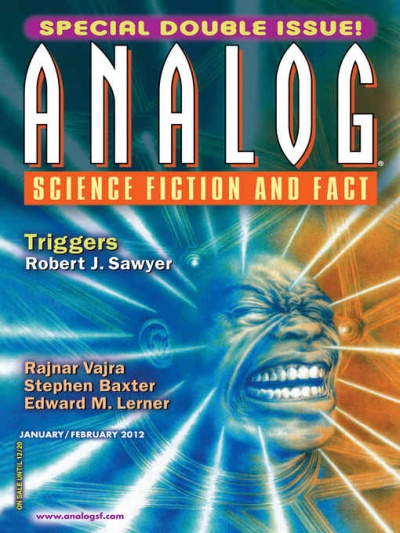
I found out about this publisher while reading the January/February 2012 issue of Analog magazine in the reference library section on page 181.

Armchair sells short story collections, novels and doubles.  Just look at some of these covers and you'll get the idea.  Sounds like campy fun.

Saturday, 4 February 2012

Magazine Review #5 - Analog, January-February 2012

Triggers (Part 1 of 4) by Robert J. Sawyer:  I don't read enough of Sawyer's work; a Canadian SF author who has such a clean, easy to read way of telling a story.  Set in the near future USA, terrorists are hard at it; many bombings have occurred all over the US.  The story opens with the shooting of the president as he's delivering a speech at the Lincoln Memorial.  He's rushed to the hospital.

Meanwhile, at the same hospital, a doctor is trying to help a patient cope with post traumatic stress.  He's developed a new technology to help and is using it on his patient while the president is in surgery in the next room.

A bomb is detonated emitting an electromagnetic pulse that effects the treatment and has dire consequences that we only begin to understand in this installment.

This story should appeal to all kinds of people; action thriller types, conspiracy fans, medical science fans, etc.  I really enjoyed the story so far.  Lucky me I received the next issue in the mail last week!

An Interstellar Incident by Catherine Shaffer: The quite funny story of a person trying to host a dinner party for human and alien, the Tuladan, dignitaries.  The trouble comes in the form of how to host a polite, inoffensive dinner when each species is disgusted by each others' eating habits.

Listen Up, Nitwits by Jack McDevitt:  Another rather funny story; this one about how humanity is saved from World War III.  There is a rather hart-warming yet sad twist ending that I liked.

Probability Zero - Return of the Zombie Sea Monster by Michael F. Flynn:  A fun bit of two-page flash fiction about a cast of characters trapped in a world of cliches.

The Alternate View - Talking About My Generation by Jeffery D. Kooistra:  In the wake of the Fukushima nuclear disaster, Kooistra, who is a freelance physics consultant, writes about changing the methods of producing electricity from current nuclear technology.  It's been long known that there are safer methods of producing nuclear energy and that is what is discussed in this essay.  I found it fascinating.

If the subject interests you Kooistra suggests you start at this website -  http://energyfromthorium.com/

Special Feature - What Science Means to Me by Jerry Oltion:  The beauty of the scientific method and living in a scientific age is discussed.  Oltion also lightly touches on theology and its conflicting views with science.  A well thought out essay.

Humanity by Proxy by Mark Niemann-Ross:  This was a touching story that was connected by the invention of a useful military tool; something called a sawhorse.  Think of mechanical pack mule and you'll get the idea.  The story starts off in June of 2114 Tiffany is a healthy 111 year old but is suffering from Alzheimer's and along with medication is provided with a sawhorse to keep her safe in case she gets lost.

Tiffany's connection to the sawhorse is revealed as the story progress backwards in time to June 2092.

This was a touching little story that still proves how military spending can positively affect our lives. It's so ironic to think that tools designed to help us kill each other can then be turned around and used in a different way.

Ninety Thousand Horses by Sean McMullen:  An alternate history, steam punk story that was just wonderful.  I was completely taken in by it.  The story begins in the middle of World War II, 1943, Bletchley Park where a story is told about how a mad-scientist type invented a rocket back in 1899.

I don't usually read steam punk but I really do love the look and feel of it and I was not disappointed with this story.  The author has a fertile mind.

Special Feature - Theme: The Art of Writing "About" Something by Richard A. Lovett:  The creative process is endlessly fascinating to me.  I'm always watching the DVD extras and eat up interviews with authors.  Anybody who can site Joss Whedon in an essay has my attention.  I really enjoyed this piece.

Project Herakles by Stephen Baxter:  Another alternate history story this time set in 1960's Britain during Harold Wilson's time as Prime Minister.  It touches on the coup attempt of the time and adds giants to the story.  Yep, giants.

The story was okay, I enjoyed the story line that dealt with the coup more than the giants plot line.  The ending was quite cartoony but there was no other way to sort out the story.

Doctor Alien and the Spindles of Infinity by Rajnar Vajra:  Great title - too bad I couldn't make it past the first few pages of the story.  I found it so boring that I just gave up on it.

***

Confession time - I hate aliens.  They bore the fuck out of me.  So many pages are spent on describing alien physiology, alien culture, alien communication, alien history ..... Come on!  Get on with the story!  As soon as I see tentacles you've lost me.

I didn't mind the aliens of Star Trek simply because the were extrapolation, distillations, if you will, of the human condition.  Klingons = violence, war and honor.  Ferengi = capitalism.  Vulcans = intelligence and knowledge.  Romulans = suspicion and secrecy.  They help explore the human condition which is pretty much what all story telling is about.  Trying to talk to a big pile of goo is just not interesting.  Sure, if it really happened that way then yes, you'd have to figure it out.  But in a story, meant to entertain, it's just not interesting. To me.

Comment -  I'm worried that I'm getting too old for the Science Fiction of the day.  Having been born in 1965 I was surrounded by Soviets, Americans, Moon Landings, Space Probes and general Space Enthusiasm.  In the fiction of today, as in the reality of today, space seldom comes up in conversation or political policy so it probably makes sense that there are no longer stories of humans exploring or trying to make a living in space.  It saddens me because these are the stories I want to read and they are becoming less common.

I want to read stories where humans live, work and play in space.  The story could take place on Earth so long as there are ships out there that a character can board and get off-planet.  I want space travel to be as common as air travel as common a driving a car.  Rember the wonderful quote between Wash and  Zoe on Firefly?

Wash: That sounds like something out of science-fiction.
Zoë: We live in a spaceship, dear.
Wash: So?


That's what I'm talking about.


If anybody can make suggestions for my reading that will give me the above, please let me know.


Thursday, 26 January 2012

Book Report #37 - Golden Gate Bridge

History and Design of an Icon
by

Sue and I are taking a trip to San Francisco so I thought I'd read up on the place a little bit.

One of the first icons to pop into my mind were; the streetcars, the Transamerica Pyramid, Alcatraz, Lombard Street, the Presidio and The Golden Gate Bridge.

I found this little book in the Edmonton Public Library and found it to be very informative.  What surprised me the most was the complete lack of archival photos; the book was illustrated completely with original sketches.  These drawings proved to be very informative and clear but I would have liked to have the sketch and a photo to make the examples stand out.

In any event the book proved to be up to date and complete; it touched on every subject I was interested in.

I'm glad I read it.


Sunday, 8 January 2012

Magazine Review #4 - Asimov's February 2012

Murder Born by Robert Reed:  Ooh, I liked this one.  This takes capital punishment in a very interesting direction.  In the story a new method of capital punishment is invented with the unintended consequence of bringing the dead back to life.  This story brings the moral questions of CP to a new level that I just found incredibly interesting.  A real winner.


Hive Mind Man by Rudy Rucker & Eileen Gunn:  This story was a bit out there.  At first it reads like a simple dating story set in the future but then it takes on a life of its own and takes social media and advertising in dizzying directions.  It left me scratching my head.  Entertaining? Yes. Interesting? Sure


The Voodoo Project by Kristine Kathryn Rusch:  An elite covert, military team meet for the first time in a vacant high-rise apartment.  One of the members is a ESPer (I don't know the term, but you get it - ESP) who's job it is to evaluate the team itself.  The evaluation does not go as usual.  Very good story.  It was Rusch's name that drew me to the issue.  I have never been disappointed by her writing.

Observations On A Clock by D. Thomas Minton:  I first found Minton's work on Lightspeed Magazine's website and found his story “Thief of Futures" very, very compelling.  I was very happy to find his name on the cover of the magazine.  This is a story of faith, of trying to save humanity from itself, but in the end the story kind of went over my head.  I'm sure I missed something; the only thing I'm sure about is that there is a monk on an asteroid with a dying atomic clock on it.  He's supposed to report back to Earth what he's observed. Yea, didn't get it.

The People of Pele by Ken Liu:  A nice story about human colonization, the effects of time dilation on a mission that traveled at near light speeds, politics and the definition of life.  I could read a lot more from this author.

Going Home by Bruce McAllister & Barry Malzberg:  A strange a quirky story told in letters between an author and his editor.

Saturday, 7 January 2012

Books I Have Not Read


Or more to the point:  Books I've Given Up On.

I start and give up on as many books as I read completely.  I thought it would be fun to track the books I've given up on in 2012.  I'll keep a list of them on the right side of the blog.

My first entries are for a Star Wars trilogy.  Over Christmas I was looking for something easy to read; I found a Han Solo adventure that I thought would fit the bill at my local used bookstore; Wee Book Inn.

Written by Roger MacBride Allen the Corellian Trilogy was dull, dull, dull.  189 pages into book 1 and NOTHING happened.  I do get it: it's a trilogy you've got to expect a bit of exposition but the thought I kept coming to is:  How much exposition do you need?  It's Star Wars - the world has been built.  The books are even conveniently inserted into a timeline (18 Years After the Battle at Yavin) so you have a general idea of when you are in the "World."

If I'm reading book 1 just to read book 2 then what is the POINT of book 1? 

I've never been a fan of writers padding their works and I get bored very quickly if nothing interesting happens.

So, my first three entries for 2012 are: Ambush at Corellia, Assault at Selonia and Showdown at Centerpoint.