Wednesday, 9 May 2012

The guilty pleasure of reading

Reading is held in high regard. It is my favorite pass time but it does come with a cost.

Reading is a solitary activity. It does not lend itself to conversation unless the parties talking have each read the same book. When I read I'm usually locked away in a room, by myself, not talking to any one.

That's part of the cost. As much as I love it, it is a bit of a selfish act. So it's hard to find the time to read guilt free.

Then there's the reading itself; what do you read? Classics, literary fiction, genre fiction, magazines, newspapers, etc.?  I love fiction above all other types of reading. But I sometimes come away feeling like I might have spent my time better by reading something more important.

I've decided that I read for my own pleasure and knowledge. I'll follow my heart as to what I read.

There is so much joy to be found in books that I can't help but be drawn to book shops of any description. Used bookstores are the best of all. There you'll find treasures long out if print at discounted prices.

One day eBooks will open the entire back list of the written word at an affordable price but right now the book readers are ahead of their time.

Content is still very expensive. I was looking for a Dirk Pitt adventure that is over 30 years old and was stunned to see it for sale as an eBook for over $10.00!! How can this be? Surely vendors know that you can get the same book for less than $2.00 in a used book store. Or Zero if you download a pirated copy.

You can wipe out most of the piracy in media by simply charging a realistic price for the product. $10 for electrons? No way. $2.99? Much better. Saves me the trip to the used bookstore. $0.99? I'm not even going to look anywhere else; I'll just download a copy.

If publishers embraced eBooks as simply another type of book they'd be able profit from it.  It used to be that the hard cover came out first then, a year later, the paperback.  Why not wait another six months to a year and then release the eBook?  And while your at it offer the entire back list of an author in eBook as well.  Some people, like myself, are completists and want to read books from the beginning.  Surely there is money to be made from that.

iTunes has sold billions (that's with a B) of songs at $0.99. Books would sell just as quickly at a reasonable price.


Wednesday, 2 May 2012

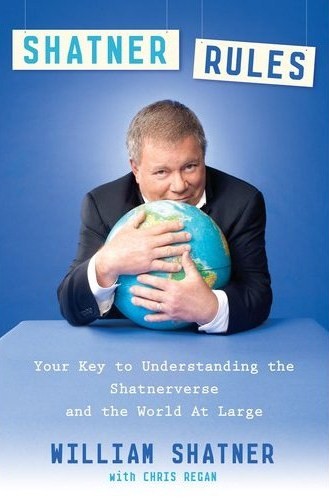
Book Report #43 - Shatner Rules by William Shatner

by

Following close behind his wonderful memoir, Up Till Now, Shatner Rules is a fun romp through the life and mind of William "call me Bill" Shatner.  There is quite a bit of overlap from his memoir but this books' tone is much more like sitting in on a conversation with the man.  

You'll hear a lot of the same anecdotes but with a sense of humor and the wisdom gained from the passing of time.  Mostly it's tongue in cheek but there are many moments of clarity.

In chapter 3, titled Busy is Measured in Units of Shatner,  he explains:

"How do I keep up on a two- to three Shatner day?  I keep mindfully aware that another day is around the corner, another day for me to play a part, another day for me to get things done, another day to make sure the dogs aren't setting their sights on the sofa.

That's how I do it.

The sweet spot of the book is how Shatner connects  his reaction to his 40th birthday compared to his 80th; which is at once touching, scary and hopeful.

He also goes on the tell the story of his lifetime achievement awards and concludes with:

"There's finality to this life achievement business that I want no part of.  As long as you're able to say "yes," the opportunities keep coming, and with them, the adventures.  Say "no" to fear and complacency.  Keep saying "yes." and the journey will continue.

In this, my eightieth year of my life, I should be settling down, taking it easy, resting on laurels.  Forget it."

My favorite rule?  (Use your best Shatneresque voice here)

Get. Out. Of. Bed.

So,

Buy. This. Book

It's Shatner's World. We Just live in it.

Friday, 27 April 2012

Murder in a Time of Siege - short story review

Murder in a Time of Siege
 by

Set in the town of Mafeking, 1899, during the Boer War this is a nice bit if historical fiction steeped in British resolve.

More a tale than a mystery one can try to solve while reading, it still had a satisfying puzzle to it.

This story was collected in:

Past Crimes: Perfectly Criminal 3

The book is sadly out of print but you can still find copies in the used book market; you can start your search HERE. 


Wednesday, 25 April 2012

Abandoned book - No Rest For The Dead


There are two kinds of deaths that scare me; trapped in a sinking ship with the water rising and capital punishment.  Both of these scenarios send shivers down my spine.  It must be the wait that terrifies me; the certainty that you are going to die and those critical moments when death is upon you.

In No Rest For The Dead the story opens with the convict waiting in her cell for the warden, chaplain and guards to come and get her.  Then entering the death chamber and seeing the gurney with all the medical equipment waiting to perform a lethal injection.  Gha!  Oh my god! Instant lump in my throat and elevated heart rate!  

The scene was so well written that I had to stop reading for a while just to recover from it.  Oh, and did I tell you?  The execution does not go well.  Shit. 

No Rest for the Dead is an interesting project; each chapter was written by a different author, each one of them best-selling.

--------

The story truly begins long before the events that open the book.  We follow "Christoper Thomas", curator of a prestigious San Francisco art museum, as he steals valuable art and uses a female  staffer for his own gains.

He's arrogant and despicable and I was very happy with the knowledge that he would soon be dead. But the book was taking too long to get to the end of his story and into the meat of novel that I found myself putting it down for days.

It's well written and I have no complaints about that but all if these events were explained on the dust jacket so I find myself wondering when these guys are going to stop with the exposition and get on with the story of righting a wrong.

---------

The discovery of the body - oh boy -  wonderfully disgusting  and scary.

A perfect set up for the Kathy Reichs chapter

---------

Page 118, that's as far as I could get.  Although there were parts of the book that I really liked for the most part I just could not bring myself to care enough to continue reading.  Try as I might I found myself putting the book down for days at a time. 

A big part for my decision to abandon the book was the never-ending exposition (which was explained on the dust jacket) and the never-starting investigation Jon Nunn was supposed to embark on.

And, maybe, that's the real problem; the dust jacket - it gave away half the book in three paragraphs making the reading a chore - I kept wanting to get to something new and then I realized that something new is a different novel.

Wednesday, 18 April 2012

Book Report #42 - Crossroad Blues by Ace Atkins

 Crossroad Blues
by


Crossroad Blues was published in 1998, the book is set in a pre-Katrina, Pre-9/11 world of New Orleans, Lousiana and the Mississippi Delta.  Nick Traverse, an ex-NFL player turned turned blues historian, at Tulane University, is asked to find a missing professor.

The whole story delves into, and is influenced by, the life and death of Robert Johnson.  In the book there are nine records that Johnson never released and was hidden in the Delta for decades.  These records would be priceless to whoever could find them; once the hunt is on for the demos the body count begins.

I've got a rule: 50 pages.  If you can't hold my interest after 50 pages then I'm done with the book.  Something made me revise the rule to 75 pages and in those extra 25 I found the story.  Atkins took a lot of time setting up the whole Mississippi blues mystique and in particular the life of Robert Johnson.  It got to the point where I had to read the blurb about the book just to remind myself what the book was about.  Yup, it's supposed to be a mystery but it kept being a history book.  Atkins can be forgiven since this was his first published novel.

Once the action started I was very happy with it.  But Atkins just couldn't help himself and kept stopping the story to give the reader more blues history.  This kind of thing always distracts me; if there is some background needed then it would be better told during the story, like on a drive to the next town, instead of coming to a full stop and filling pages with exposition.

Aside from that complaint, Atkins has a wonderful ability to steep the reader in local sights and sounds; I could practically smell the spilt beer and could feel the heat of the summer nights.  I loved following Traverse into Jo Jo's bar.

In the end I found the whole thing quite satisfying.  I was very happy with the ending and it gave the whole book a warm glow.

I've already purchased the eBook version of Leavin' Trunk Blues.

PS - The reason I read Atkins in the first place was because of the knowledge that he was tapped to pen the next Spenser novel.  Spenser may yet live on without Robert B. Parker; Atkins was a friend and chosen by the family to continue the series.  Read about it here.

Monday, 2 April 2012

Book Report #41 - Case of the Vanishing Beauty by Richard S. Prather.

Case of the Vanishing Beauty
by

Prather is my favorite author from the paperback area of mystery fiction.  Published in 1950, I was lucky enough to read a 1962, Gold Medal reprint of Prather's first Shell Scott novel.

Being a fan of Robert B. Parker's Spenser novels I've always been happy to know that there are 42 Shell Scott novels waiting for me as well.  Both authors had fantastic dialogue and humor in their books.  I've come to look forward to Prather's opening paragraphs where he typically describes a woman.  

In this book a beautiful woman comes to Scott's office asking him to find her missing sister.  The story then uncovers the world of drug trafficking and cults.  For a fist book this one had plenty of twists and I was surprised at just how relaxed Prather's prose came out.  The book came it at 160 pages making it just the right length for a tight mystery story.

Like I said, I like Prather's style, here's an example:

She looked hotter than a welders torch and much, much more interesting.
She was in her early twenties, and tall.  About five nine, and every inch of it loaded.  Her lips were the dangerous red of a stop light and her eyes were the same black as the masses of black hair piled high on top of her head.  She was slim, but with hips that were amply ample and high, full breasts that she was careless about but nobody else would be.  Plus a flat stomach, a slim waist, and golden skin smooth as melting ice cream.

 Prather was hard-boiled here's a passage that I found chilling:

After so long a time you get a little sick of violence.  You see guys gasp and bleed and die, and it makes you feel a little funny, a little sick while its happening, when it's right in front of your eyes.  But it isn't ever quite real when it's going on, when you're in it.  Maybe a muscle man slugs you, or a torpedo takes a shot at you, or you're pulling the trigger yourself or smashing a fist into a guy's face, and you're hurting or crippling or killing some trigger-happy hood.  But when it's actually happening, you've got adrenalin shooting into your blood stream, your heart pounds, your breath comes faster, pumping more oxygen into your veins.  Glands and body organs start working overtime to keep you sharp, keep you alive, and you're not the same; you're not thinking like the same guy.  It's all kind of blur like a picture out of focus jumping in front of your eyes, and you don't think much about what's going on, just let your reflexes take over.  If the reflexes are trained right, and if you're lucky, you come out of it scared but O.K.  Nothing to it; all over.

But when it is all over, when you've got time to think, that's when you get sick remembering vivid little details you hardly noticed at the time.  The way a body jerked when a bullet ripped through fine skin and flesh and muscle and bone, or the way it jerked just before it stopped being a man and became what they call down at the morgue a "dead body" or the "deceased."  Maybe you even wonder what kind of man he was, what he liked for breakfast,  when he was born, stupid things like that -  and wonder what made him get a gun in his hand and like the feel of it.  Maybe you even wonder what it is that goes out of a man when 158 grains of lead drive into his brain or his heart.  Maybe you get sick and your stomach turns upside down and then it's all over and you forget about it.  Almost.

So to hell with it. 

 I ate it up.  A very good book.

Sunday, 18 March 2012

Book Report #40 - Drive by James Sallis

by
James Sallis

 I was searching for a movie to watch, not long ago, when I saw the Ryan Gosling trailer for Drive; now THIS looked like an intense movie.  Unfortunately we didn't watch it - it was not what we were looking for at the time.  But the story stuck in my head and I  searched for it on the web and discovered the movie was based on a novella by James Sallis.  Coming in at 158 pages this is the kind of crime novel not seen in decades.  I was happy to see it available as an ebook and downloaded it to my Kobo Vox.

I loved how Sallis toyed with the time line; starting in the middle and flashing back and ultimately forward in the story made it very enjoyable.  I was not able to read it in one sitting, although it felt possible, and I did suffer a bit of confusion when I put the book down for a couple of days then tried to remember where I was when I picked it up again.  So I would suggest giving yourself plenty of time to sit back and enjoy the story.

This is a wonderful example of neo-noir, gritty, scary and very, very interesting.  The story revolves around a gifted Hollywood stunt driver who moonlights as a get-away driver for criminals in his spare time.  In time the life of crime is more alluring to him and he is slowly drawn in to the world completely.

I've always been fascinated by stories like these; how can a normal person turn to a life of crime?  I found myself rooting for him to make the right choice only to watch him spiral further into a world he can't control.  It was great stuff.

I'll be watching the movie this week, for sure.

Tuesday, 6 March 2012

Book Report #39 - The Drop by Michael Connelley

The Drop
by
Michael Connelly


Michael Connelly is a household name and his books are well reviewed everywhere so I'm not going to pretend that my thoughts are going to make much of a difference.

Connelly is actually on my must-read-in-order list but sometimes I'm loaned a book and feel that I should read and return it in a timely manner, plus his novels are so well written that a person can jump in at any point and not feel left out.  I've dabbled in Connelly's work and I've never been disappointed.  His plots are tight, his narrative is quick and his characters leap off the page fully formed.  Sometimes I like to cast the movie version of the books in my head; I still don't know who should be cast has Harry Bosch.

The Drop was another good read, in it Bosch solves two cases both of which have nice surprise twists.

Connelly is also good at giving his fans little treats along the way; I really liked his tip of the hat to Castle.  Connelly has appeared two or three times, as himself, on the show so it was fun to get a reference in the book.

It was a very enjoyable book.

Friday, 10 February 2012

Book Report #38 - San Francisco's Powell Street Cable Cars

Images of Rail
By
Emiliano Echeverria and Walter Rice

In preparation for my trip to San Francisco I bought this book for some insight into the famous cable cars.

The book itself is dedicated mostly to archival photos with lots of informative captions. What narrative there is in the book is used mostly to explain the differing eras of the system.

I had no idea their history would be so colourful. The system was always under threat of closure; it was first saved by the citizens of SF in a 1947 vote; then the system itself was designated a national historic landmark in January, 1964. From 1982 to 1984 the entire system was shut down and essentially replaced and rebuilt.

The book was wonderful; full of interesting stories. I'm glad I read it and I can't wait to step on to one. Considering what I now know about them, a ride will be very special to me.

Wednesday, 8 February 2012

Classic Science Fiction


Wow!  If you are in to classic/vintage science fiction then point your computer-machine to Armchair Fiction.

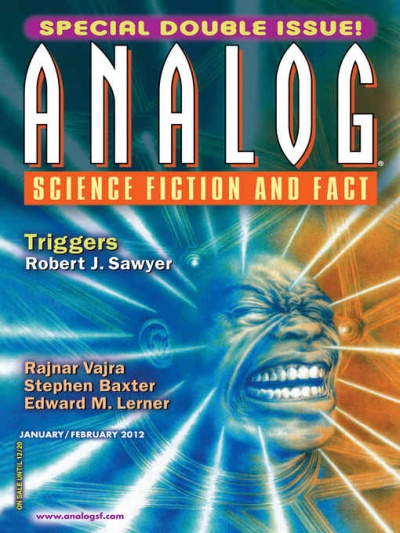
I found out about this publisher while reading the January/February 2012 issue of Analog magazine in the reference library section on page 181.

Armchair sells short story collections, novels and doubles.  Just look at some of these covers and you'll get the idea.  Sounds like campy fun.

Saturday, 4 February 2012

Magazine Review #5 - Analog, January-February 2012

Triggers (Part 1 of 4) by Robert J. Sawyer:  I don't read enough of Sawyer's work; a Canadian SF author who has such a clean, easy to read way of telling a story.  Set in the near future USA, terrorists are hard at it; many bombings have occurred all over the US.  The story opens with the shooting of the president as he's delivering a speech at the Lincoln Memorial.  He's rushed to the hospital.

Meanwhile, at the same hospital, a doctor is trying to help a patient cope with post traumatic stress.  He's developed a new technology to help and is using it on his patient while the president is in surgery in the next room.

A bomb is detonated emitting an electromagnetic pulse that effects the treatment and has dire consequences that we only begin to understand in this installment.

This story should appeal to all kinds of people; action thriller types, conspiracy fans, medical science fans, etc.  I really enjoyed the story so far.  Lucky me I received the next issue in the mail last week!

An Interstellar Incident by Catherine Shaffer: The quite funny story of a person trying to host a dinner party for human and alien, the Tuladan, dignitaries.  The trouble comes in the form of how to host a polite, inoffensive dinner when each species is disgusted by each others' eating habits.

Listen Up, Nitwits by Jack McDevitt Another rather funny story; this one about how humanity is saved from World War III.  There is a rather hart-warming yet sad twist ending that I liked.

Probability Zero - Return of the Zombie Sea Monster by Michael F. Flynn:  A fun bit of two-page flash fiction about a cast of characters trapped in a world of cliches.

The Alternate View - Talking About My Generation by Jeffery D. Kooistra:  In the wake of the Fukushima nuclear disaster, Kooistra, who is a freelance physics consultant, writes about changing the methods of producing electricity from current nuclear technology.  It's been long known that there are safer methods of producing nuclear energy and that is what is discussed in this essay.  I found it fascinating.

If the subject interests you Kooistra suggests you start at this website -  http://energyfromthorium.com/

Special Feature - What Science Means to Me by Jerry Oltion:  The beauty of the scientific method and living in a scientific age is discussed.  Oltion also lightly touches on theology and its conflicting views with science.  A well thought out essay.

Humanity by Proxy by Mark Niemann-Ross This was a touching story that was connected by the invention of a useful military tool; something called a sawhorse.  Think of mechanical pack mule and you'll get the idea.  The story starts off in June of 2114 Tiffany is a healthy 111 year old but is suffering from Alzheimer's and along with medication is provided with a sawhorse to keep her safe in case she gets lost.

Tiffany's connection to the sawhorse is revealed as the story progress backwards in time to June 2092.

This was a touching little story that still proves how military spending can positively affect our lives. It's so ironic to think that tools designed to help us kill each other can then be turned around and used in a different way.

Ninety Thousand Horses by Sean McMullen An alternate history, steam punk story that was just wonderful.  I was completely taken in by it.  The story begins in the middle of World War II, 1943, Bletchley Park where a story is told about how a mad-scientist type invented a rocket back in 1899.

I don't usually read steam punk but I really do love the look and feel of it and I was not disappointed with this story.  The author has a fertile mind.

Special Feature - Theme: The Art of Writing "About" Something by Richard A. Lovett:  The creative process is endlessly fascinating to me.  I'm always watching the DVD extras and eat up interviews with authors.  Anybody who can site Joss Whedon in an essay has my attention.  I really enjoyed this piece.

Project Herakles by Stephen Baxter:  Another alternate history story this time set in 1960's Britain during Harold Wilson's time as Prime Minister.  It touches on the coup attempt of the time and adds giants to the story.  Yep, giants.

The story was okay, I enjoyed the story line that dealt with the coup more than the giants plot line.  The ending was quite cartoony but there was no other way to sort out the story.

Doctor Alien and the Spindles of Infinity by Rajnar Vajra:  Great title - too bad I couldn't make it past the first few pages of the story.  I found it so boring that I just gave up on it.

***

Confession time - I hate aliens.  They bore the fuck out of me.  So many pages are spent on describing alien physiology, alien culture, alien communication, alien history ..... Come on!  Get on with the story!  As soon as I see tentacles you've lost me.

I didn't mind the aliens of Star Trek simply because the were extrapolation, distillations, if you will, of the human condition.  Klingons = violence, war and honor.  Ferengi = capitalism.  Vulcans = intelligence and knowledge.  Romulans = suspicion and secrecy.  They help explore the human condition which is pretty much what all story telling is about.  Trying to talk to a big pile of goo is just not interesting.  Sure, if it really happened that way then yes, you'd have to figure it out.  But in a story, meant to entertain, it's just not interesting. To me.

Comment -  I'm worried that I'm getting too old for the Science Fiction of the day.  Having been born in 1965 I was surrounded by Soviets, Americans, Moon Landings, Space Probes and general Space Enthusiasm.  In the fiction of today, as in the reality of today, space seldom comes up in conversation or political policy so it probably makes sense that there are no longer stories of humans exploring or trying to make a living in space.  It saddens me because these are the stories I want to read and they are becoming less common.

I want to read stories where humans live, work and play in space.  The story could take place on Earth so long as there are ships out there that a character can board and get off-planet.  I want space travel to be as common as air travel as common a driving a car.  Rember the wonderful quote between Wash and  Zoe on Firefly?

Wash: That sounds like something out of science-fiction.
Zoë: We live in a spaceship, dear.
Wash: So?


That's what I'm talking about.


If anybody can make suggestions for my reading that will give me the above, please let me know.


Thursday, 26 January 2012

Book Report #37 - Golden Gate Bridge

History and Design of an Icon
by

Sue and I are taking a trip to San Francisco so I thought I'd read up on the place a little bit.

One of the first icons to pop into my mind were; the streetcars, the Transamerica Pyramid, Alcatraz, Lombard Street, the Presidio and The Golden Gate Bridge.

I found this little book in the Edmonton Public Library and found it to be very informative.  What surprised me the most was the complete lack of archival photos; the book was illustrated completely with original sketches.  These drawings proved to be very informative and clear but I would have liked to have the sketch and a photo to make the examples stand out.

In any event the book proved to be up to date and complete; it touched on every subject I was interested in.

I'm glad I read it.


Sunday, 8 January 2012

Magazine Review #4 - Asimov's February 2012

Murder Born by Robert Reed:  Ooh, I liked this one.  This takes capital punishment in a very interesting direction.  In the story a new method of capital punishment is invented with the unintended consequence of bringing the dead back to life.  This story brings the moral questions of CP to a new level that I just found incredibly interesting.  A real winner.


Hive Mind Man by Rudy Rucker & Eileen Gunn:  This story was a bit out there.  At first it reads like a simple dating story set in the future but then it takes on a life of its own and takes social media and advertising in dizzying directions.  It left me scratching my head.  Entertaining? Yes. Interesting? Sure


The Voodoo Project by Kristine Kathryn Rusch:  An elite covert, military team meet for the first time in a vacant high-rise apartment.  One of the members is a ESPer (I don't know the term, but you get it - ESP) who's job it is to evaluate the team itself.  The evaluation does not go as usual.  Very good story.  It was Rusch's name that drew me to the issue.  I have never been disappointed by her writing.

Observations On A Clock by D. Thomas Minton:  I first found Minton's work on Lightspeed Magazine's website and found his story “Thief of Futures" very, very compelling.  I was very happy to find his name on the cover of the magazine.  This is a story of faith, of trying to save humanity from itself, but in the end the story kind of went over my head.  I'm sure I missed something; the only thing I'm sure about is that there is a monk on an asteroid with a dying atomic clock on it.  He's supposed to report back to Earth what he's observed. Yea, didn't get it.

The People of Pele by Ken Liu:  A nice story about human colonization, the effects of time dilation on a mission that traveled at near light speeds, politics and the definition of life.  I could read a lot more from this author.

Going Home by Bruce McAllister & Barry Malzberg:  A strange a quirky story told in letters between an author and his editor.

Saturday, 7 January 2012

Books I Have Not Read


Or more to the point:  Books I've Given Up On.

I start and give up on as many books as I read completely.  I thought it would be fun to track the books I've given up on in 2012.  I'll keep a list of them on the right side of the blog.

My first entries are for a Star Wars trilogy.  Over Christmas I was looking for something easy to read; I found a Han Solo adventure that I thought would fit the bill at my local used bookstore; Wee Book Inn.

Written by Roger MacBride Allen the Corellian Trilogy was dull, dull, dull.  189 pages into book 1 and NOTHING happened.  I do get it: it's a trilogy you've got to expect a bit of exposition but the thought I kept coming to is:  How much exposition do you need?  It's Star Wars - the world has been built.  The books are even conveniently inserted into a timeline (18 Years After the Battle at Yavin) so you have a general idea of when you are in the "World."

If I'm reading book 1 just to read book 2 then what is the POINT of book 1? 

I've never been a fan of writers padding their works and I get bored very quickly if nothing interesting happens.

So, my first three entries for 2012 are: Ambush at Corellia, Assault at Selonia and Showdown at Centerpoint.

Sunday, 13 November 2011

Book Report #36 - Branded Woman by Wade Miller

by
This is one of my many Hard Case Crime books that I've been collecting for years.  I only dip into them once in a while.  They are such at treat to read that I don't want to rush through them.

This story really showed its age.  There was some pretty stilted dialog and some rather narrow minded views of women.

This is a story of revenge, Cay Morgan is on her way to Mazatlan to kill a man.  She's a thief who got in the way of a rival know as The Trader.  He kidnapped her and branded her forehead with the letter 'T' as a warning to stay out of his business.  For five years she's been trying to track him down.

The story started off pretty nicely, exotic locale, independent, strong female character and sinister people around every corner.  Unfortunately the whole story unraveled at exactly page 152 where she instantly turns into a dish rag and wants to give everything up simply because she's finally found - A MAN!

What?!

No Way!

Boo!

Up to this very moment she'd been smarter and tougher than anybody she'd come across but one roll in the hay and she loses every ounce of credibility!  It took me so completely out of the book that I couldn't enjoy the last 50 pages.  The book had a very satisfying ending but it just didn't matter because I lost all respect for Cay.

To be fair; this was written in 1952 so the stereotypes are not be much of a surprise; it's just that the scene on page 152 went completely against her character that it just blew it for me.

So, okay, here it is (I just have to share this) the last few paragraphs of chapter 21.

SPOILER ALERT!  If you still want to read the book (and you should, it's good) but don't want to know what I'm talking about, do not read beyond this point.

"Look at me," he commanded. She looked at him, and his face was a frightening sinewy mask.  "You've got something else now. Me.  I'm yours and you're mine.  I've taken you over and I've taken over your debts.  I'm not asking you to give up anything.  But from now on, I pay the bills for both of us."

"No, Walt!  Afterward, I can come to you,belong to you truly --"

His hand went out to the table, picked up his long-barreled revolver that lay there.  "This belongs to me.  So do you.  I'll handle you both."  He put the gun back and pulled her slowly to his chest, showing her his brutal strength.  "Do you believe me?"

She felt his mouth master her, felt her resolve melting into his reservoir of male power.  She cried desperately, "I want to believe you!  Oh, how much I want to believe you!".


"I'll show you."  He released her and went to the lanterns on the wall.  His eyes locked with hers, he said, "Now we can put out the lights, like normal people, for normal reasons."  She held out her arms to the darkness, and he found her.

"Beautiful," he said, "Any time -- in the light or in the dark -- you're the most beautiful woman in the world.  And you're mine."


"Yes," she said, "Yes, my darling."

I've needed you always, her trembling form implored him, and even as she clasped him to her she thought joyously, I belong to somebody, at last I belong to somebody!


[wow]

Friday, 11 November 2011

Book Report #35 - Pacific Vortex by Clive Cussler

Oh my God - what fun!

Clive Cussler has a special place in my heart.  I read him a lot when I was a teenager (sadly a long time ago) and I grew out of his books in my mid 20's.  With my interest in pulp fiction it didn't take long to rediscover good 'ol Cussler who has not slowed down one bit.

This guy is in his 80's now and is only increasing his output by teaming up with all kinds of authors including his own son, Dirk.  The authors he's teamed up with are, Paul Kemprecos, Craig Dirgo, Jack Dubrul, Justin Scott and Grant Blackwood.

The basic story goes like this:  There is an area in the Pacific, north of Hawaii, called the Pacific Vortex, that has, for decades, has been known for ships disappearing with out a trace, just like the Bermuda Triangle.  Along comes a newly built American nuclear submarine and it too goes missing.  Our hero, Dirk Pitt, finds the captain's log capsule floating in the ocean and takes it directly to the US navy.  Thus begins the adventure and with the weight of the US navy the mystery of the Vortex is uncovered.

Pacific Vortex was the first Dirk Pitt adventure written by Cussler but was the sixth in publication order.  This is like American James Bond stuff!  Complete with an evil overlord in a hidden fortress of doom!  There are many tropes that Cussler uses that, like the James Bond films, if they are not present the book feels incomplete.  There is always a beautiful woman who falls, usually tragically, in love with Pitt, there is his best friend and partner Al Girodino and there are the cars.  Oh, the cars are wonderful and sadly the cars also come to tragic ends as well.  But not in this story  Here Pitt drives an AC Cobra into the sunset with nary a scratch on her.  Whew!


This was pure pulpy fun!  Knowing that it was written in the 70's and published in 1983 the story actually stands up very well.  There are no glaringly obsolete technologies mentioned and the story feels just like a James Bond movie.  If you like action, adventure, exotic locations, beautiful babe, humor and men being men - you really can't go wrong with this book.

Tuesday, 8 November 2011

Book Report #34 - Perry Rhodan - Enterprise Stardust

Perry Rhodan, Book 1
by
K. H. Scheer & Clark Darlton

This is an interesting story in the world of publishing.  Begun in 1961 this German science fiction series has been in constant publication, written by a team of authors, for nearly 50 years!  To stagger the mind a bit more; it's published weekly!  The series is sold in instalments and many story arcs (or cycles as they are know in this series)  can range from 25 to 100 issues before the tale is told.

The universe of Perry Rhodan is revisionist; substituting Neil Armstrong as the first man on the moon with Perry Rhodan and his team.  Written a bit like the Doc Savage stories of the 30's Rhodan is the brains behind everything while his team members represent the best in his field.

In 1969 Ace Books began publishing English translations of the series in mass market paperbacks.  If you haunt used book stores, like I do, you'll see loads of these books still floating around.  The difficulty is in finding the early issues in publication order.  Ace published 118 books in the series before ending the project due to lack of sales.

I was able to find PDF editions of the books on-line and converted the first five books to EPUB and loaded them onto my new Kobo Vox.

This first story sets the stage in the series; Rhodan and his team crash land on the moon because some energy beam interfered with their remote controlled landing sequence.  Once safely on the surface Rhodan discovers another crash-landed ship.  This one is most definitely alien in origin.  They make first contact and discover they are in a position to help the aliens in exchange for advanced technology and Rhodan's desire to unite all the people of Earth, which would allow humans the opportunity to join a galaxy-spanning society filled with alien races united under one old (and failing) government.

You can see all the popular science fiction movies taking parts of this series and using them in their own stories.  First Contact, Galactic Empires, Humans discovering they are not alone - all of it is here.

Even more fun is the cheesy 60's and 70's attitudes that prevail and how 50 years of scientific progress renders these stories charmingly dated.


Sunday, 6 November 2011

The Bastard Mummy by Frank Zafiro - A short story review #1

by

Here's another example of why I like this author.  Zafiro has proven to me that he's a versatile author.

In this story he stays within the world of River City but delivers a classic locked-room whodunit.  Laced with a classic cast of characters, from the snooty academic to an ex-con, officers Elias and Finch try to solve the theft of a valuable mummy.

This was a nice light change of pace but never forgetting the grittiness of River City.  The ex-con, in particular, was written with enough understated menace that you could feel the author was taking it easy on the reader.  This story could easily have been published in Ellery Queen Mystery Magazine.

Nicely done.

Wednesday, 2 November 2011

Book Report #33 - Bimbos of the Death Sun

by

Wow! What a fun ride. The title is a bit misleading but that's the point of it. This is actually a murder mystery set at a science fiction convention. And believe it or not, this fun little book won the 1988 Edgar Allan Poe award for best paperback original.

Anybody who's been to a con will appreciate this story. What makes it fun is the fact that it's set in the 1980's (the book having been published in 1988.) with all of the "high tech" of the day.  The cast of characters, however are still among us - they are timeless and McCrumb treats the community with respect.

The story is very funny, in a self-deprecation way but the characters jump off the page which made this story a nice bit of fresh air.

I came to this book via a podcast that I recently found.  At some point Seth Harwood made a shout out to the Flash Pulp podcast.  Curious, I found it and started to listen to a few shows.  These people put out original flash (read short) pulp fiction and pepper the podcast with the occasional "behind the scenes" show.  It was during one of these shows that the hosts mentioned the new book club they've created and how Bimbos was to be the first read.

It wasn't easy to find a paper copy that I could get through the mail in time to read before the deadline of the book club.  So on a lark I did a search on the Kobo website and found it as a ebook!  I threw the book on my iPhone and read it in no time. (This ebook thing is really going to open up the back catalogs in a few years.  It's gonna be great!)

For anyone who's even a little bit geeky this book would be fun.  If you've ever been to a con (think the Calgary Comic Expo) and the book will jump right into your imagination.


Saturday, 29 October 2011

Magazine Review #3 - Asimov's, August 2008


August 2008

I've got to say that all in all this issue really did not deliver on the promise of Science Fiction.  The cover art is not tied to any of the stories within. 

I'm getting the feeling that Asimov's might not be the magazine for me since I like my Science Fiction with space ships.  I don't have to be in space but I like knowing that the ability to get out there is possible.  Only one of these stories satisfied that need but only in a very limited way.


Lagos by Matthew Johnson: This was an interesting story.  I liked it.  It took the whole third world call-center industry to a whole new level.  Plus there is the recurring theme of the man-machine interface that has been cropping up a lot in SF lately.  It was a satisfying read.  I really felt the desperation of the main characters.

Old Man Waiting by Robert Reed:   I'm confused.

I cannot figure out why this story is considered Science Fiction.The story goes like this: some dude spots an old man sitting on a park bench, he decides the old guy looks queer and DECIDES he's an alien.

And SPOILER ALERT - he's exactly what he seems to be - an old man with Alzheimer's. How does this qualify for publication in this magazine?

Pass on this one.

Lucy by J Chris Rock:

Set in the near future, two engineers, working from their Hell's Kitchen apartment, on a robotic probe on Titan find that neighbourhood has an influence on their mission.

Not a bad story but it's set so near in the future that there is very little sense of wonder in the story. The descriptions of the Titan environment were satisfying but I couldn't help thinking that this particular mission is only a matter of time and forgone.

I'd call it a piece of literary fiction with a splash of science thrown in before I'd call it SF.

Divining Light by Ted Kosmatka:This story started in a deep, dark noir aesthetic. But soon it turned into an egghead quantum physics story that completely lost me in the end. By the time the story ended I was completely baffled.

Perhaps that was the intention, after all, a couple of the supporting characters were as confused as I was.

It's a lot like the Schrödinger's cat thought experiment.

Yea, this one sailed completely over my head.

Wat You Are About to See by Jack Skillingstead:  This was a strange little story: part Area 51, part Guantanamo Bay and part Twilight Zone. It deals with an alien interrogation and the nature of choices and possibilities.

The story was very "televisual" which I could see if it was being filmed but in the case of the written word I'm not sure the visual of a 7-11 in the desert was necessary. It was still a moving tale which made me hope the best decision would be made.

Wilmer or Wesley by Carol Emshwiller:  Another head-scratch.  Think - monkey escapes from the zoo.  The story is from the point of view of the monkey.  Fair enough but the monkey is not a monkey; he seems to be human.  Okay.  Why is he in a zoo?  Don't know.  What is so different about him?  Never told.  Why is it the citizens don't recognize him as anything else but human?  Still not let in on that detail.

The main character does not know why he's in captivity and the author has deemed it unnecessary to explain it to the reader.  Fair enough if you are trying to convey what it must feel like to be a zoo animal.  But once again I really don't feel like I've been told an SF story.

Radio Station St. Jack by Neal Barrett, Jr.:  What a great title.  This was another disappointment for me.  Not because it was poorly written but mostly because it was not what I expected.  I think I can be forgiven for thinking that it would have something to do with the cover art but really it was a western.  Okay, sure it was set in a post-apocalypse world so it's closer to a Mad Max setting but it just read like a western with all the stilted dialog that comes with it.

Was it good?  Well, it was okay.  The end gave it some gravity for me; it was more about how a small town survives in a world without law and order.  We are shown that we are only one war away from the Wild West.

Sunday, 23 October 2011

Magazine Review #2 - Analog - December 2011

December 2011

Still on a short story kick; I received the latest issue of Analog in the mail just when I finished reading Amazing Stories.  And look who has a story in this issue - that's right - Kristine Kathryn Rusch!


1- Ray of Light by Brad R. Torgersen:  This was a fantastic story!  Man is trying to survive at the bottom of the ocean after an alien attack triggers a new ice age!  This was a very believable story told without any literary fluff; just a straight-ahead, nuts-and-bolts, hopeful story.  I loved it.

2- Turning it Off by Susan Forest:  An interesting little tale about teen-age suburban life in a time when computer controlled safety devices are implanted in everything; including humans.  What a fun idea!  If Steve Jobs were still alive I'm sure he'd try to implant the iPod in people.  Wait maybe he already has that on a drawing board somewhere at Apple HQ.  Hmm.

3- Freudian Slipstream by Brad Aiken:  Interstellar travel is possible by using hibernation and an AI interface to keep a person's mind active during flight.  In this story a problem is solved en route to a new planet just about perfect for human habitation.  I loved the pacing of this story; very relaxed and confident.

4- Hidden by Kyle KirklandSet in a time after a drug was developed and used on children to give them heightened intelligence it's discovered that these same children become insane in adult life.  Now one of these people has taken over a secret weapons lab and is threatening to set off the prototype bomb.  We follow Robinson as he negotiates with him.  I'd call this story more of a thriller than a Science Fiction story, sure there's some super weapon and a"brain" drug but that's as far as the SF is pushed.  Was it a good story?  You bet.

5- Art for Splendor's Sake by Dave Creek:  I don't know.  I feel that I was missing something when I read this story.  Earth Unity Ambassador Chanda Kasmira is overseeing a complex evacuation of the planet Splendor an ironically named planet who's description brings to mind the Rocky Mountains in February.  The planet is under threat from a fast-approaching nebula when along comes an artist . . .

By the end the artist reveals his work and Kasmira's reaction left me feeling like I missed the point of the story.  After finding Mr. Creek's website I discovered that this is the seventh or eighth story in a series so now I understand my feeling of disconnection.

The story was crisp and well paced.  It felt like it could have fit well in the Star Wars universe: I got the feeling of a much larger world out there from the story that I read.  I'm looking forward to reading more from him.  I also have over three years worth of back issues to read and I know that he has many stories buried in there.

The Impossibles by Kristine Kathryn Rusch:  Here she is again!  My favorite modern SF author with another fresh take on life in the future.  In this story we follow Kerrie, a new lawyer, two years on the job, working for the Earth Alliance Inter Species Court for the First District.  She's a public defender working off her student loans when the case of a lifetime comes to her.

Set in Rusch's Retrieval Artist universe the story felt like it was part of a larger world to me but it was such a satisfying read on it's own that I didn't get the same feeling of having missed something like I did reading Art for Splendor's Sake earlier in this issue.

Not for Ourselves Alone by Charles E. Gannon:  What a fantastic story!  Part alien invasion, part military SF with a nod to The Cold Equations.  A seemingly unstoppable alien invasion force is on its way to Earth; after attacking a Jupiter orbital space station the survivors find a weakness but can they get the message back to Earth in time.  A fantastic Old-Time space opera tale.

Conclusion - this is issue is well worth a read.

Friday, 14 October 2011

Magazine Review #1 - Amazing Stories, May 1990


May 1990

In the field of Science Fiction Amazing Stories looms large.  It's been around since the 1920's.  Although it's no longer in publication today there are still loads of back issues floating around in used book stores and garage sales.  The copy I have is in near perfect condition.  The pages have yellowed but I don't think this copy has ever been read.

I decided to read this as a bit of a break from the last novel, which was ponderous to me.  So some short stories in the SF genre seemed the ticket to refresh my brain.

One of my favorite authors in the field is Kristine Kathryn Rusch and she has a story in this issue, which, I'm sure, is the reason I bought it.

Reading it also gives a glimpse as to where SF was 20 years ago, a bit of a time capsule really.

1- Giant, Giant Steps by Robert Frazier:  Not a bad story.  Set in Chicago during the Second Great Depression.  The story revolves around Marty and his friend Rita.  Marty works as a tele-soldier fighting a distant war via a computer connection to a "Stiff" a robot he controls.  To work the robot his consciousness is transferred directly to it therefore he still runs the risk of dying.

Music has all but vanished from society, when Marty leaves work he goes to his local bar where he and Rita spend time together. On the wall the bartender displays an old relic -  a Saxophone.

While on a mission Marty tries to save a platoon-mate.  A transfer of abilities occurs and Marty can now hear things like never before.  He can hear music in nearly every sound.

Back at the bar he picks up the Sax.

2- Computer Portrait by Jayge Carr:  Again: not a bad story.  This one also delves into differing realities.  An artist living in the loft of an abandoned building is tormented by his computer.  It watches him all the time and critiques his paintings while in progress; estimating and predicting the final product and just how much money he can expect to make from them.

His creativity is in jeopardy because of it.

He turns the computer off and starts to meet interesting and seemingly sinister people who move into the building.

We discover that his life is very much being controlled not by the computer but by the people behind it.

The computer is never really off.

3- The Animist by Bruce Boston:  I didn't read this story.  As soon as I was dealing with another "altered reality" story I gave up.  He lost me when the character was looking for his shoes and found one on top of his stereo.

Stories where reality is doubted I find tiring.

4- Pins by Joe Clifford Faust: This was a fun story!  Take a pinball machine and cross it with Fight Club and you'll have an idea of how this story feels.

Building on the human/machine interface that this issue seems to be about this story takes a fresh approach is very entertaining.  It has a noir, Blade Runner underground setting where a stranger is challenged to take on a pinball machine with an AI built into it.

Strange and fun.

5- Saint Willibald's Dragon by Esther M. Friesner:   I skipped this one too.  Science Fiction and Fantasy are often grouped together but, in my mind, they are very different genres.  My tastes don't run to fantasy and I'm always disappointed to find such a story in an SF magazine.

No offense to Ms. Friesner.

Fatal Disc Error by George Alec Effinger:  This was an interesting story.  What happens to an Artificial Intelligence when it dies?  Again this story goes in and out of all kinds of "realities" as the AI dies due to a fire where it's servers are kept.

A Time for Every Purpose by Kristine Kathryn Rusch:  The best story of this issue.  Rusch is one of my favorite authors.  She does loads of short fiction and she crosses from SF to Fantasy to Romance and Mystery.  I first read her SF short fiction but also found her mystery fiction to be first rate.  Her voice is fresh and her stories are always clear and believable.

This is a "time cop" story.  The main character is traveling through time trying to prevent a serial killer from committing his first murder.

The story weaves back and forth and plays with history as we know it.  It was a first rate read.

Tuesday, 4 October 2011

Book Report #32 - Beneath A Weeping Sky

by

Zafiro had me at page one, up until now.

It's not really his fault; the book is written very well and there is a greater ease to his writing.  You can see that he is growing as an author - he's telling a story much more than in previous books where it felt like he was explaining the story.  By the end of the book he's allowing his characters to make a joke without telling us that he's making a joke.

It took me weeks to read the novel.  I just kept putting it down and leaving it for days at a time because it suffered from two major flaws.

Flaw #1 - it was too damn long.  This thing weighs in at 460 pages!  I am of the mind that if you can't tell a story (especially a cop story) in 300 pages or less you're not trying, or your editor took the week off, or you're just trying to up your page count.  Either way I found myself wishing the author would just get to the point.  Even the denouement went on for over 30 pages!

I know that fiction readers like a longer books, it makes them feel like they are getting a better deal on the purchase price of the book.  But for me, the opposite is true; the thinner the book the more "potent" the story.  Why mess around and fill the book with fluff?  Tell me the story, don't tell me how the house was furnished - I don't care!

Flaw #2 - the story was about a serial rapist.  No different than a serial killer - the story is about a crazy guy.  I don't get crazy and I don't care about crazy.  Why?  Because they're C-R-A-Z-Y.  It's boring.  I'd much rather read about a sane person doing terrible things for a reason.  Nut-jobs with mommy issues are just not that interesting to me.  

To me.

Was it well written? Absolutely
Was it interesting?  Not to me but loads of people love this stuff.

What would have made it better?  250 pages less.

Had the book been shorter, much shorter, the story would not have dragged on and I would have been able to suspend my disinterest of crazy people.  I would have liked it a whole lot more.

Sorry Frank.

NOTE - Zafiro has three collections of short stories that I will purchase as ebooks.  I am by no means down on Zafiro just this novel.  It was a short story that drew me to his work in the first place.  I'm looking forward to reading more of his short work.

Sunday, 2 October 2011

Deadly Storm

I'm a big fan of the ABC TV show, Castle.  I've bought the three novels published so far.  (I've read the first two)

Today I read the first graphic novel from the show.  This is written by Brian Michael Bendis and is an "adaptation" of Castle's first novel published before the events of the TV show.

I'm a huge fan of Nathan Fillion and I'm thrilled that his show is doing so well.


Because I like the show I'm a sucker for all the spin-off merchandise.

I liked the graphic novel.  There was action, sexy women and humor, exactly what you'd expect from Richard Castle.

The producers of the show are doing a great job breaking down the fourth wall by giving us these books.

What fun.